Thursday, November 04, 2010

1:10: The Only Scale

Before I leap too much further into sharing more of my AWI battle plans, I realized it might be worth your time to talk a little bit about scale and rules.  The American Revolution can be tidily divided between the northern war and the southern war.  The north features those classic actions such as Bunker Hill, Trenton, Princeton, Brandywine, Germantown, Saratoga, Monmouth and a host of other actions.  These tend to be good sized, actions, with Washington fielding over 18,000 men at Monmouth.  That's a passel  of troops and a worthy subject for a 1:20 action. 

My interest in the Southern campaign, however, showcases zero battles of such size.  The largest battle is Guilford Courthouse, with about 2,000 British and 4,000ish Americans.  The other four battles are much smaller indeed. It's a campaign that calls out for 1:10 scale.  Why?  Setting aside Guilford which has a bunch of 250-400 man units on both sides, most of the participating units are small.  At Hobkirk's Hill and Eutaw Springs many of the British units are 140-160 men strong.  Those are sixteen figure units, or four stands at 1:10.  At a larger scale they'd be only a couple of stands.  One of my favorite units is Kirwoods Delaware Regt., a stud unit that wears very cool bed-ticking trousers.  They are effective light infantry with an influence on a battle well beyond their 80-110 men.

There are some snags with the 1:10 scale.  I am not convinced that the groundscale always works.  I have some very large Continental units at 40 figures or ten stands.  They take up 15 inches on the game table.  That seems like a lot of room. What about large units that can fight in open order, such as the British 33rd Regiment.  What if one end of a ten stand unit is attacked?  What then?  I guess I need to do some more reading.
Despite the ground scale concerns, I can't envision another way to do the South in a larger scale.  If nothing else the historical feel is gone and you have tiny units.  How do you show the 50 17th Light Dragoons at Cowpens, or William Washington's Continental horse at each of these five battles.  Lee's Legion would be a speck.  These units and others influenced battles far more than their tiny size would indicate-and the more there are, the cooler they look. I also think it's best in 28mm.  There, I said it.  I'm slime, but I admit it.  I haven't seen any 15mm AWI I'm particularly enchanted with, and would you really trade in your Perry figures for 15mm Old Glory?  I think not!

Rules are always an open question with me.  Most of the games I want to run/plan are geared around   conventions or with friends who aren't familiar with the rules or the period.  So, they have to be fairly easy easy to pick up with reasonably simple mechanics. I own a copy of British Grenadier rules, which I hear lots of good things about.  If I had an intact group of regulars interested in the period, I'm sure I'd play these.  They are adaptable to 1:10 and have a couple of useful scenario books.  Unfortunately, that's not the world I live in.

A couple of years ago I began writing, or perhaps deriving would be a better term, a set of AWI rules from Fire and Fury.  At that time, Regimental Fire and Fury was still in its 275th beta version and publication was not on a foreseeable horizon.  I was also intrigued with the Hasenauer spawned "Wars of America" Regtl. F and F rules intended to serve a wider audience covering the American Revolution through the Mexican War.  Those rules are still unaccounted for.  Because Fire and Fury, together with The Sword and the Flame, are the greatest rules every written I decided to adapt my own version I called Tarleton's Quarter.  These were intended to be written at a 1:10 scale and aimed at the American Revolution in the South.  With those rules I hope to capture the more open formations the British used, and the closer integration of regular troops, provincials, and militia that was a regular feature of war in the Carolinas.

Saturday, October 30, 2010

Number 1: Cowpens

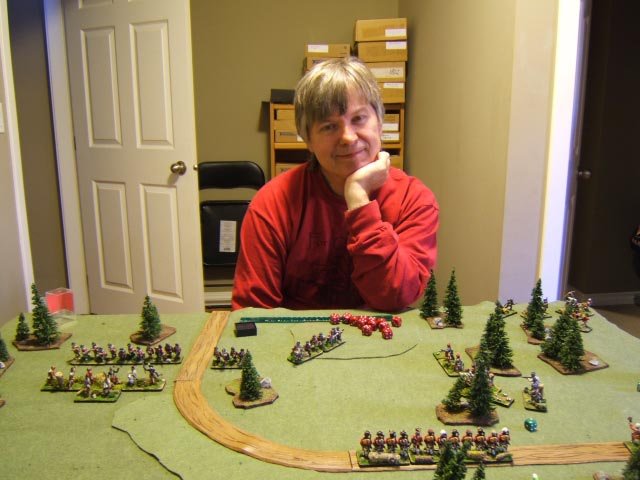
Cowpens is the first battle of my series chronologically, and also the first of the battles I've actually run.  I covered this battle extensively on this blog in 2008 .  It's a challenging battle to do.  For those of you who don't know the action, a combined arms force of British regulars and provincials under Banastre Tarleton ran headlong into a novel defense developed by General Daniel Morgan in the South Carolina backcountry.  Morgan deployed a defense in depth of three lines, the first two of militia and the third of veteran continental light infantry with support from various mounted elements.  Tarleton was decisively defeated when his rapidly advancing troops were enveloped on both flanks by cavalry and the militia that retired in front of his advance.

It's a tough battle to game, and the mechanisms have to be right or the militia simply gets run over and the small force of Continentals is overwhelmed. It's a game I hosted at Enfilade a couple of years ago and the game turned out pretty historically, with the Brits taking some damage when confronting the line of militia, and the British Legion foot being rocked by a blast from the Continentals.  Failed charges by the British cavalry resulted in an envelopment of the British left and the end of the game.

All the units are painted and the unit strengths are based on those in Greg Novak's American War of Independence: Book Two the Southern Campaigns
British Order of Battle
17th Light Dragoons     6 figures (3 stands)
British Legion Light Dragoons 24 figures (3 troops of 4 stands)
British Legion Infantry     24 figures (6 stands)
Light Infantry Battalion    16 figures (4 stands)
7th Foot                         20 figures (5 stands)
1st Batt. 71st Foot         24 figures (6 stands)
Royal Artiller  1 section 3 pdrs.

American Order of Battle
Maryland/Delaware Light Infantry Battalion     36 figures (9 stands)  3rd Line
Virginia/South Carolina State troops                12 figures (3 stands)  3rd Line
Triplett's Virginia Militia                                   16 figures (4 stands)  3rd Line
1st and 3rd Continental Light Dragoons           8 figures (4 stands)    Cavalry Reserve
Virginia/North Carolina Light Horse                 4 figures (2 stands)   Cavalry Reserve
McCalls Carolina/Georgia Light Horse/Volunteer Light Horse 8 figures (4 stands) Cavalry Reserve
Roebuck's Spartanburg militia                        12 figures (3 stands)
Thomas's Spartanburg militia                          16 figures (4 stands)
Hayes' Little River militia                                20 figures (5 stands)
McDowell's North Carolina militia                  24 figures (6 stands)

Tuesday, October 12, 2010

Limits to Growth: My AWI Project

I just finished reading David Sullivan's blog post on having too many projects to manage.  I am sympathetic.  I do cop to his comment that I have good focus and can be productive, at least in a short term, say three or four months, then I have to take a break and do something else.

My American Revolution project is where it's at for me right now.  Yes, I definitely have other things to do too-Spanish Civil War, American Civil War in 15mm, 28mm and 1/600 naval, the First Jacobite Rebellion, 28mm War of 1812, and a plethora of others to work on, but right now AWI has me by the nipple ring.

I've written a lot about my War of Independence project.  The conflict is interesting, I love the variety of troop types, with British and American regulars, Tory regulars, militia galore and the spectre of Indians fighting on the frontier. So many battles, so many troop types and so little time. This being the case I narrowed my interest to the year following the Battle of Camden to the fall of Yorktown.  In fact I went even farther than that-I limited myself to battles in the Carolinas from 1781.

While it's certainly possible to fight a bunch of one-off battles with the pile of units that took part in this southern campaign, I am, of course, lured by the battle-sized historical actions, and there are five of them.
1. Cowpens (January 21, 1781)
2. Weitzel's Mill ( March 6, 1781)
3. Guilford's Courthouse (March 15, 1781)
4.  Hobkirk's Hill (April 25, 1781)
5. Eutaw Springs (September 8, 1781)

These omit large numbers of smaller actions that could easily be fought in  skirmish or semi-skirmish actions between formations of British infantry and/or Tory militias and American militia units under Francis Marion, Thomas Sumter and others.

It is my plan to paint each unit involved in these actions at 1:10 and apply them to the appropriate order of battle. I'll review each of the battles, together with my progress toward making them available for a game.

Sunday, October 10, 2010

It's Been a Weird Month

Yeah, I know it's time for another post.  It's the first month of school and I find myself working longer hours and enjoying it a bit more, so I've had less time for game-related activities.  I also haven't had a whole lot to write about what I have been doing.

I have been painting pretty regularly and I've purchased some new figures.  I am mostly focused on my RevWar figures right now.  I'm finished painting the figures for my 5th Virginia Regiment, 40 figures strong.  It will be full strength for all the major actions it participated in-Guilford Courthouse, Hobkirk's Hill, Eutaw Springs-as it diminished in strength from 400 men to 180 men.The figures are Perry Miniatures, a combination of figures types from their Continentals in southern dress.  They are very nice figures, with lots of variation available. I chose an example of a thirteen star flag from Richardson's Flags and Standards of the American Revolution. The Liberty flag, which is hard to see, comes off the Danish Wargames page.


I'm also working on a new British unit, the New York Volunteers.  Okay, they aren't exactly British regulars, but they are a smallish loyalist unit that served in the south.  I'm also painting them green.  Usually that's a no-no by the time provincials headed for the Carolinas.  But it's clear they were issued with green jackets in 1780 as they embarked for Charleston, and red jackets some time later.  Would they have had them at Hobkirk's Hill? That's debatable, and I'm guessing they probably wouldn't but I'm okay with it because it adds some variation. These are also miniatures from the Perrys' British infantry in southern dress.


I'm working toward fighting Hobkirk's Hill for Enfilade.  It's a pretty straight up action, with another post to follow to explain.  I've got a couple more units ready to paint.  One is James Coffin's small unit of light dragoons, and the small converged unit of invalids that also fought at Hobkirk.

Wednesday, September 01, 2010

The Summer in Review

Tomorrow is September 2nd and the first day of school.  As a teacher, I always calculate my calendar a little differently than other folks.  The summer has more meaning for me.  How did I use my free time?  What did I get done?

Most importantly, how was the gaming?  Did I get any painting done?  I think I can safely say it was a good summer for gaming.  I got in four Truants gatherings, a trip to Surrey to play with Doug, and the Summer Skirmish outing all made for a satisfying bunch of games.  I even left out the super thrashing the Martians gave the Brits over Shastapsh.  It WAS a good summer for games.

Most importantly, I dragged out my SCW and 1/600 ACW naval  projects.  It got folks talking about them, and made me play with them and fiddle with the rules a bit more. 

It was a productive painting summer too.  I finished about 200 15mm Spanish Civil War figures.  I also made big inroads on painting two of the big AWI Virginia regiments.  4th Virginia is done, and the 5th Virginia is half done.  I'll wrap it up in September.

Looking ahead to fall.  I'll wrap up the Virginians and move on to paint up more SCW figures (I have enough for three more units or 66 figures and three vehicles.  After that it'll be some AWI loyalist horse.

Saturday, August 28, 2010

Sometimes History Gets the Better of Me

 When I began miniature wargaming forty years ago I played WWII armor.  I think everybody starts there.  We played with Roco minitanks because they were cheap back then, and later we played with GHQ micro armor.  What was everyone's favorite tank?  The German King Tiger of course.  They were big, nasty, had a wicked 88mm gun and could easily slay T-34's or Shermans.  That there were only 200 plus of them made while thousands of Panzer IV's, Panthers, or the previously mentioned Russian and American vehicles were manufactured in the tens of thousands made little difference.  King Tigers were cool.

Yesterday when I got home from our game, I began to have that nagging King Tiger feeling. In our Wilmington game I'd try to apportion the Confederate guns reasonably, so that there were about 50% rifled guns and 50% smoothbores.  In Fort Anderson there were five total guns.  Of those, one was a 7" double banded Brooke rifle and another was a 6.4"  double banded Brooke Rifle.  Battery Johnston, near the board entry for the Union, also had a 6.4" double banded Brooke Rifle.  The Martello tower had a British 100 pdr Blakely rifle, and Battery Trimble near the opposite entry point for the Yankees had a 30 pdr Parrott rifle.  The Confederate ships also had some rifled artillery.  The rebel ironclad, modeled on the Raleigh, a Richmond inspired ram mounted four 6.4" Brooke Rifles.  The Morgan, according to the Ironclads board game mounted a pair of 7" Brooke double banded rifles.  Silverstone's Warships of the Civil War Navies disagrees and gives the Morgan 7 inch rifle and a 6.4 inch gun.

So, in yesterday's game there were nine Brooke rifles.  Why is this important and what does this have to do with King Tigers?  More than you might think.  Brooke rifles were considered the finest rifled guns of the American Civil War.  They were more accurate and had longer ranges than the Federal Parrotts, and were also less prone to bursting than the numerous Parrotts.  We know the first Brooke rifles were mounted in the Virginia when it fought the Monitor in 1862, and they appeared in the James River flotilla when they fought the Federal fleet on the James River at Trent's Reach in February 1865.  The CSS Atlanta was armed with them (we know because the captured guns are on display the Washington Navy Yard), the Tenessee II was armed with them at Mobile Bay (we know because they are on display in Alabama.)

The problem is, Brooke naval and seacoast guns were scarce as hen's teeth.  The number of Brooke rifled guns was something under 150 tubes.  Brooke rifles were cast and bored at the Tredegar ironworks just outside Richmond, and at the Selma foundry in Alabama.  Though Tredegar cast more than a thousand cannon, less than a hundred were Brooke rifles.  Spencer Tucker in his excellent Arming the Fleet states the Tredegar works cast less than 83 rifles and 16 smoothbores.  Tucker goes on to claim the Selma foundry cast 53 rifles and 18 smoothbores.  Edwin Olmstead in his book Big Guns: Civil War Siege, Seacoast, and Naval Artillery, breaks the quantities down even further:
 6.4" Brooke Rifle

Only four 8-inch rifles were cast at the Tredegar works.
Tredegar produced 26 single banded 7-inch guns, 36 double banded 7 inchers, and three triple banded guns.  Selma produced 54 7-inch tubes, but shipped only 39 due to casting flaws.
Tredegar also produced 35 single and double banded 6.4" rifles, while Selma managed 15 usable 6.4" guns.
Some flawed 6.4" and 7" castings were rebored as 8" smoothbores.

This is a problem for me as a scenario designer.  So many of the vessels in the Ironclads rules call for Brooke rifles, and that just can't be, there weren't enough to go around to all the ships and coastal fortifications that often find their way into our wargames.

Tucker reminds us the Confederates captured the Gosport Naval Yard at Norfolk in 1861.  In addition to the hull of the USS Merrimack and the magnificent drydock needed to convert her to a massive ironclad, rebel forces also captured nearly 1,200 heavy naval guns.  Though some were modern shell guns, including 52 IX- inch Dahlgrens, not one was a rifled gun.  Additional guns and naval stores fell into Confederate hands when they captured Pensacola.  So there was a passel of guns out there, many of them quite modern, but rifles would have to be imported from Great Britain (Blakely's, Whitworths, or Armstrongs) or they'd have to be made.  Tucker relates the Confederates favorite conversion was to bore out a 32pdr and band the breach.  Voila, instant rifle, that is covered and rated in Ironclads.

I've done a bit of a search to determine the gun types present at Fort Sumter during the unsuccessful sea assault in April of 1863.  At that time the fort mounted some forty pieces of artillery.  They can be seen here. Not one Brooke rifle is listed.  The only rifles appearing are rebored 32 pdr and  42 pdr smoothbores, or "James" rifles that fired 64 and 84 pound rifled projectiles.  These appear in the Ironclads rules as the Army rifle. The 42pdr was a standard seacoast weapon which appeared after the War of 1812.
Collection of James Rifles.  32 pdr on field carriage, and 42 pdr on fortress carriage in the background
In any case, it seems to me I'll need to give some thought to redesigning the fortress armament for the Wilmington defenses.  I don't want anyone to leave the game feeling like they'd been King Tigered.

Closing Wilmington Revisited

Today was the last of our Truants wargaming days I'll be able to attend. I'm back in the classroom on Monday with students arriving on Thursday.  There's little question I'll try to organize another Truant session next summer all things being equal.

I tweaked the ACW naval game from July and ran it out on the table.  Fellow truants expressed their interest, and the game was successful enough that I wanted to try it again.  Two changes were suggested for the scenario.  One was forcing the Union ships to the middle of the table.  The other was changing the already simple infantry rules to forego the roll for command pips.

I addressed both those issues in the scenario redesign.  First I added a partial across river shoreline and stuck a two gun battery on it.  I believed it would force the Union vessels more toward the middle of the table and give them more to think about.  It would also give the Confederate gunners better opportunities to engage Union ships at more effective ranges. I also did something daring and near the far end of the table put an island surmounted by a Martello tower mounting a Blakely rifle.  I know Martello towers were not common to the United States, but there was one on Tybee Island guarding the approaches to Savannah, so it would not be out of the question to have one guarding Wilmington.  Besides, I had one, it looked cool, and it is just a game. The tower could fire into the center of the table, and once again give something else for the Yankees to think about.

I made two additional changes.  First I simplified the command for the infantry rules.  Each brigade commander had a four inch command radius rather than rolling for pips a la DBA.  I also wanted to make the Confederate naval presence a bit more formidable.  In the previous game the Richmond class ironclad was accompanied by two small Maury gunboats and a torpedo launch. Though the ironclad gave as good as it got the escorts were easily dispatched at a considerable distance.  I replaced the three small vessels with the gunboat Morgan from Mobile Bay.  I figured it would be a bit more of a challenge, and rightfully so as it turned out.

There was one complication to the game and that was the light attendance. Mark Waddington, Al Rivers, Tom Bieker and Darin Howard made their truant excuses and escaped to play.  It happens, it's nobody's fault.  The game is designed for 7-8 and we only had four.  I figured I could fairly play a Confederate gunner, so I let Tom Bieker run the Confederate squadron and most of the guns. Al, Mark and Darin ran the Union vessels.

I actually love this scenario because it puts the Union players in such a tizzy.  The decision making is all on them.  The Confederates have few choices to make.  The timetable decides for them. With all decisions made and the table set up, the Yankees moved their vessels on to the table.

With two batteries facing the entries, the Union fleet decided to capture one with their naval landing party, and pound the other to rubble.  In this they were pretty successful.  By turn six of the game, the two batteries were either silent or nearly so.  The naval landing party was on its way to capture the western battery, and the Union fleet was headed for the middle of the table. Most of the rebel fire targeted the leading Union vessel, the double-ender Miami.  Though the gunboat suffered some light pecks and pokes, nothing serious seemed to slow her down. The two rebel ships, however, were also moving downstream to engage the leading Union vessels, and that's where things got interesting.

First, Darin, commanding the three 90 day gunboats in the squadron, made a boo-boo and stepped into the clearly marked minefield with USS Huron.  He made a couple of die rolls, and struck a mine which was, happily, a dud.  Unfortunately, his movement didn't take him safely out of the field.  A second turn of moving through the danger zone didn't turn out so well and turn seven saw the Huron engulfed in a bright flash and disappearing rapidly to the bottom of the Cape Fear River.

Turn seven also saw the loss of USS Miami's good luck charm.  Two telling shots from the Martello tower and the Brooke rifle in Fort Anderson did significant damage.  However these were followed by a shot from the Morgan that exploded in Miami's magazine, resulting in the instant sinking of the vessel.  Not an easy shot by any means, and one we rarely see in the game. We played through turn eight, as the luck decisively turned in the Confederates' favor.  The monitor Montauk had a waterline seam opened up and suffered flotation damage, and the Union fire could not seem to shake loose the last gun crew from Battery Trimble at the mouth of river.  Despite hitting the battery ten or twelve times, the fire would scatter off the remaining gun (only a 33% chance of it doing so.)

It was agreed that with the loss of two ships and accumulating damage to others the Union would pull safely back and concede a Confederate victory. The game actually started out very much like the first game.  The Union fleet seemed completely capable of dispatching the Confederate batteries, then their die rolling went cold.  Though the Confederates occasionally hit the Union vessels, they seemed incapable of turning the hits into something decisive against the wooden vessels.  About   turn six the Yankees went south and the Confederates got lucky.

This is a game I'd like to run at Enfilade, but I'd like to play test it some more.  I started out with the idea it could be a twenty turn game.  However, it's more likely to be something on the order of twelve turns, so I'll need to rethink the objectives and victory points a bit.  Maybe allow the Union to set up on the table rather than move on, which might require some change in battery placement.

Thursday, August 19, 2010

Work in Progress: Greene's Virginia Regiments.

Sometimes I get captured by a period and put everything else down to work on it.  June it was Spanish Civil War, July and August it is the American Revolution.  As I've stated previously, I'm very interested in Greene's Southern campaign.  That's after the disaster at Camden, but includes Cowpens, the race to the Dan, Weitzel's Mill, Cowan's Ford, Guilford Courthouse, Hobkirk's Hill, Eutaw Springs and maybe throw in the Siege of Ninety-Six.

So how does this play into my painting projects?  To do these actions there are four Continental units I have to have:  1st and 2nd Maryland, and 4th and 5th Virginia.  In their first actions these units are good sized 300-400 men.  But as the campaign winds down both get much smaller. In my 1:10 scale, those are some BIG units.  The two Maryland battalions weigh in at 36 figures, the two Virginia units at 40 figures each.  My 1st Maryland are all Front Rank figures, and one of my favorite battalions.  I painted it in the early 90's for an early Enfilade project, and they've held up well.  I painted my 2nd Maryland during the school year last year.  They're Perry figures.  I like them, but I'm a bit less wild about the paint job.  Somehow my effort at combining washes of lighter areas, such as trousers and shirts, and highlighting the brown coats didn't work out so well. Just didn't get the contrast right.The 1st Maryland were studs, veterans of the units destroyed at Camden.  The 2nd Maryland not so much.  They were trained but green at Guilford, and when they broke, it forced Greene's decision to retire from the battlefield.

I just finished the 4th Virginia.  It's a big unit and took me most of the month to complete it.  I used a combination of Old Glory Continentals in firing line and Continentals in hunting shirts firing.  Neither of these packs of figures are top of the line in terms of posing or accuracy.  The hunting shirt figures even have cuffs with buttons.  Nevertheless, I am too cheap to just not do them, and too lazy to do 16 or so figure conversions.  The 4th Virginia was one of three large trained, but unblooded undits in Greene's main (third) line at Guilford Courthouse. On the table, that's ten stands, fifteen inches frontage.  This unit also fought at Hobkirk's Hill and Eutaw Springs, though in much smaller versions in the subsequent actions.  I gave them the Trumbull standard with the rectangular array of stars and one in the middle.  They are six-pointed stars and I'm not sure I did such a good job with that.

I'm currently working on the 5th Virginia Regiment, brigaded with the 4th and commanded by Isaac Huger. It's another massive paint job, with 40 figures at 1:10.  These are Perry figures.  I love painting them because of the potential varieties in figures.  When I ordered them last Christmas, I decided on the shoulder arms pose.  Not one I usually choose.  I love the firing line figures, and the advancing poses, but, at least with the Perrys I've discovered a disadvantage in this.  They're busy enough that cramming them all on stand with muskets pointing hither and yon can lead to problems with adjacent bases, so I just kept it simple.  There is a combination of four different figure styles here-southern Continentals in regimentals, Southern continentals in single breasted coats, southern Continentals in shirt sleeve order, and black troops.  All of them are very nice and fairly easy to paint.   Lots of animation and variations. I've begun work on the twelve figures in regimentals.

Got some birthday cash and earned a little extra pay working at J-Camp a couple of weeks ago, so I've invested in enough Perry British infantry in Southern dress to paint the two Guards battalions at Guilford.  Ahh, another endless project.

Friday, August 06, 2010

Summer Skirmish-Retreat to Bilbao

Last Saturday we held a NHMGS summer gig at the Metro Seattle Gamers clubhouse in the Interbay district.  Chuck Monson arranged the get together for us and we began planning around July 1st.  There was space for four games in morning session and four more in an afternoon session, with all the sessions spoken for.

I immediately volunteered to run a Spanish Civil War game.  It's a period and rules set that everyone seems to enjoy, and I certainly like to have an excuse to pull the figures out.  I chose a rearguard scenario in the retreat through the Basque territory in early 1937.  I read Dave Boling's excellent novel Guernica in June, really enjoyed it and thought there was the nut of a game there. 

The set up allowed for a brigade of entrenched Basque militia with a brigade of Republicans retreating on to the board.  Both would be attacked by Fascist forces in larger numbers.  There was also the likelihood the Republicans would be under air attack throughout most of the day. 

A couple of things went sideways quickly.  I planned for a 5-6 player game and instead had 9.  Not the end of the world, but crowded.  I also planned for a six food wide table, and instead had more than eight feet.  Nothing to fuss about, but I stretched out the distance the Republicans had to travel by two feet and that caused major problems for them.  They were immediately attacked by advancing Fascists-part of the plan-but it also kept them much farther from their Basque support, which was bad.  I'm always making little mistakes like this and it makes me crazy.

The first action came from the Italian brigade run jointly by Mike Snively and Arthur Brooking.  The supporting CV-33 company was picked apart by artillery fire and the accompanying infantry advanced across the open into the teeth of fire by Basques in entrenchments and the town. The Republicans sprinted up the road toward the town, but not fast enough to avoid Falangist militia advancing on their heels or a Carlist brigade coming on in reinforcement of the Italians.

The Italians eventually made their way into the town to contest the Basques, grimly holding on, but the Republican brigade, just short of surrounded by Falangists and Carlists, thought  better of things, were broken and forced from the field.

An interesting game despite my several game master errors.

Thursday, August 05, 2010

My trip to Surrey

Doug Hamm lives in Surrey, B.C. and is my friend.  That's a long way from beautiful Puyallup.  Perhaps not as far as Virginia where Mike Pierce and Toby Barrett live, but Doug and I have been known to collaborate on projects and we genuinely enjoy one another's company.  I used to see Doug twice a year; once at Enfilade and another at Salute in Burnaby in March.  When I took my high school job I lost the opportunity to visit the guys at Salute because it's always the same weekend as the state student journalism convention.  Last summer Doug and his wife Susan bought a house in Surrey, just across the border, complete with a large game room.  He suggested that I come up for a visit.  I didn't have a vacation planned, or any classes I was taking so I took him up on his offer. I went up last Tuesday and came back on Thursday and had a thoroughly good time.

I went up to game, and that's pretty much what I did. That and scope out Doug's game space in the basement.  The Hamms have a full basement and it's all Dougland.  He's meticulous about almost everything he does.  His painted figures and unpainted stash are neatly organized.  He has carefully clipped magazine articles directly relating to his projects and organized them in file boxes.  His painting space is perfect with no space wasted, and indeed space available for expansion. He has a great gaming space that is comfortably suited for his 12' X 6' game table.  Doug's been very smart about his hobby.  I used to say the only aspect of my life that was organized was my game life.  Hah! Not close.  I've been organizing my stuff ever since I got home.

When I arrived and unloaded on Tuesday we began playing a series of four DBA games.  Doug had a Tuareg army he hadn't played with before.  Neither of us had a historical match so I threw out my Later Hebrews.  I may as well have thrown out an ant army.  He crushed me.  I often thought I was getting decent match-ups, trying to stay away from his camels with my chariots and using supported blades or aux to get the pluses.  No such luck.  I generally rolled poorly off and on throughout the time I was there.  Things have a habit of coming around, but I'm on about a three week jag of generally crappy die rolls. Twice the Tuaregs kicked the Hebrews all over the board. The Tuaregs are an all camelry  army, if you can imagine such a thing.  Doug was short a stand of figures so he substituted a cloud of dust for his missing nomads. In the photo he's getting ready to put paid to King Saul. Figures.  I did get my licks in later with a Welsh vs Woodland Indians match up.  First we mucked up the rules and the fact that spears are quick killed by warbands. (That's what happens when I don't engage in Barkerese for a couple of years.)  Anyway we started over and I managed to A) stick all the terrain in the corners, and B) have a much better set of die rolls to give me the win.

Wednesday was huge fun.  We played with Doug's adaptation of the Humberside DBX Rules  to the French and Indian War.  It worked very well.  Odd period to make happen with lots of Indians and irregular troops, but I really enjoyed it--even though I look a little bemused and befuddled in the picture below.

After a round or two of that we were off to navigate the Delta traffic and make our way to Imperial Hobbies.  It's a great shop.  Lots of off the shelf figures to look at.  I picked up a couple packs of GFI WWI figures that will some day go with my Peter Pig figures for Square Bashing.  Yes, it's probably down the road apiece for that project, but I liked the figures anyway.  Francis Munroe is the worthy proprietor of Imperial Hobbies in Richmond, B.C. He's a supporter of Enfilade, and his shop is a rarity these days as he tackles all aspects of gaming-role playing, board gaming, miniatures, keeps complete racks of magazines, nice selection of terrain as well as a great selection of plastic models.  We don't have anything that compares in the Puget Sound area.

After our return to Chez Hamm, Dennis Chin and Andrew Mah came over for a huge Hundred Years War game.  Loosely based on Poitiers, it was an ad hoc opportunity for Doug and I to drag out all our singly mounted figures.  It was one of those games in which the sky darkened with arrows but the French just kept on coming.  Eventually they washed over the English run by Doug and myself, and that was the name of that tune. We used my Arrowstorm rules which probably need more fiddling so that the French always lose ; ) Much fun. Great picture of Crusader miniature of King Jean II (the good) leading on his men-at-arms.  On this night he was John the Very Good.

Next morning we worked some more on the French and Indian War DBX games.  I learned to enjoy them even more.  good stuff.  By two o' clock I was on the road headed south for home.  No border crossing horror shows to tell about, though it seemed that all non-US returning cars were being sent to customs or immigration.

I would be remiss if I didn't thank Doug and his wife Susan for having me up.  It was fun, the dinner conversation was great.  It was a perfectly wonderful way to spend a few summer days.

Pics are all by Doug.

Thursday, July 29, 2010

Truants 3: Closing Wilmington-ACW combined arms

In June I read Under the Blue Pennant by Grattan Schneller.  It' a memoir by a young man who served with the Atlantic Blockading Squadron during the Civil War.  He was a lieutenant in volunteer service with the Union navy and served on the USS Malvern, a converted blockade runner that also happened to be the Union flagship for the actions against Fort Fisher in 1864-65.  After the fall of that fort, the Malvern was also involved in actions to clear Confederate batteries and minefields on the Cape Fear River and ultimately capture the city of Wilmington. Grattan's account inspired me to try my own game on the topic and that was our third Truants activity.

The Union fleet had eight ships-the monitor Montauk, two double-end gunboats, three 90-day gunboats, the gunboat Pequot, and the flagship Malvern. They had many tasks they could undertake, from clearing minefields to salvaging a wrecked blockade runner.  But chief among their goals was capturing or silencing the forts that controlled the river.  In addition to the ships, the Yankees had a division of infantry marching west toward the city. The Confederates had less to work with.  Nine guns in fortifications, half of them Brooke rifles, were the chief defense.  They also had fewer and less effective infantry.  Later arrivals were the Cape Fear Defense Force, including, a Richmond class ironclad, two Maury gunboats, and a torpedo armed steam launch. The Confederate mission was simply to inflict as much damage as possible on the Union fleet and hold as many of the forts as possible.

Most of the ships were  Toby Barrett's excellent 1/600 Thoroughbred models.  I've had them for years and still love to drag them out. One of the 90-day gunboats came in a scratch-built haul I made from Larry Enoch some time ago and had never seen battle, so I was glad to pull it out of the box.  I run all my ACW naval games with the old Yaquinto Ironclad rules.  David Sullivan and I adapted these for tabletop years ago and I still like them compared to other rules sets that are out there.  Only David Manley's Iron and Fire has made a positive impression on me, but only for large fleet actions.  Toby Barrett owns the copyright to Ironclads and I sent him my annual bitch note (as he calls it) to beg for something new and updated.  He hedged as usual. Still a nice guy.

There are no rules for infantry in Ironclads.  Of course not, it was a board game.  However the Civil War is replete with examples of combined arms actions, from Fort Donelson to Wilmington.  I painted up some of my 20 year old passle of 6mm ROS figures and wrote up some simple DBAish rules.  I didn't have a copy of the Humberside extensions to DBA so I sort of made it up myself.  Kept it as simple as possible. 

Anyway, the Union entered the board sneakily to avoid the first Confederate battery.  This would be their strategy for most of the game.  Five of the Confederates nine guns were large smoothbores, so the Yankees would obligingly stay out of their range.  The other guns, however were three 6.4" and one 7" Brooke rifles designed to reach out and touch the Union vessels wherever they could. However, while the big rifles hit, none did any catastrophic damage to force Union vessels to drop out of the game-a chief factor in the scenario rules.  No telling hits from the first battery, and the fleet trashed Battery Johnston pretty rapidly, while the Union land forces quickly advanced up the road toward Fort Smith.

The Confederates didn't have much luck with their naval arm either.  On turn four the ironclad Wilmington entered the game with its tiny consorts.  The ram quickly duelled with the Montauk only to take a crushing blast to its front casemate that cost its forward firing Brooke rifle.  Things went even less well for the tiny Maury gunboats that received loving attention from Sassacus, Maratanza, and Pequot. It did not turn out well.  The end came quickly for the Confederates.  The forts were clearly outclassed by the Union vessels, and could not offer sufficient support to the tiny flotilla.  Though Wilmington did provide a bit of redemption when it inflicted a nasty critical flotation hit to Montauk and forced the monitor from the game, it was the only bright spot.  Even on the land side the Confederates were clearly thumped.

I enjoyed the game.  With the addition of land forces, it was clear, to me at least that it was possible to do a combined arms game.  I am looking forward to running the game again on August 20th with some additions to the Confederate side to balance things out.  Can you say Martello tower?

Photos once again by Adrian Nelson.  The first picture is a Richmond class ironclad by Thoroughbred miniatures.  Wilmington is a fictional vessel based on the Richmond.  The port of Wilmington was defended by two Richmond class ironclads, North Carolina and Raleigh.  Both met untimely ends: North Carolina sank at her berth, her hull eaten by worms, Raleigh ran aground and broke her back. The second photo shows the Yankee infantry preparing to engage the Confederates.  The Union had thousands of infantry available at Fort Fisher after its fall in January 1865.  Their advance was delayed more by the swampy conditions than Confederate resistance. The next photo shows Scott Murphy's 90-day gunboat observing the earthworks of Fort Smith.  This is my only large piece of terrain that I seem to drag out every five or six years.  Battery Johnson is burning in the foreground.  Finally, a view of most of the Union fleet maneuvering in the river.  A beached blockade runner is on the left, and two Confederate minefields are on the right.

Monday, July 26, 2010

Truants 2: The Great War in Africa

Back up and running again.  If only I'd seen the tab that said Compose and realized I was in the HTML editor.

Our second Truant game was hosted by Mark Waddington.  Mark has a wonderful collection of WWI in Africa miniatures that not only covers the war in Tanganyika, but also the Middle East.  He decided to thrill us with the exploits of Von Lettow-Vorbeck.

Adrian Nelson and I ran the British troops while Joe Waddington and Dean Motoyama pushed the Germans.  The Germans had to move their supply troops, a bunch of porters on foot across the table.  Adrian and I were to set up an ambush that could interdict that supply.  The difficulty for us was determining where the ambush was best sited to deal with the numerous exit sites possible for the Germans.

We Brits had six infantry units ranging from pretty good to pretty awful, as well as two medium machine guns and a pair of light Lewis guns. We also knew we'd receive a Rolls Royce armored car which meant another medium machine gun on wheels.

The busy terrain meant this was a line of sight game.  We set up our mgs as effectively as possible and then spread our troops around the board.  We also had counters to mark our position along with some dummy counters to dilute our possible set up.  The Germans weren't so lucky, most set up in our line of sight, so they had to reveal their positions.

I held our left flank with a medium machine gun and a poor quality Indian unit that immediately were revealed and came under attack by three German units and a medium machine gun.  The gun survived but the infantry were beaten to a pulp and both were forced off the ridge they were holding. On the right Adrian duked it out with superior forces, giving better than he got with some support from the Lewis gun and Indian troops in my center.
Just as things seemed to falling apart for the Brits on the Left and the Germans on the right, the Rolls Royce arrived to shore things up a bit.  As the game ended the question to be answered was: could the porters wander around the British right as reinforcements began to move to the center.  That was unclear and Mark declared the game a draw.

Photos are all courtesy of Adrian Nelson, who has become the official Truants photographer.  Thanks.

Sunday, July 25, 2010

Blog issues

As some of you may have noticed, I've been having trouble with posting pictures. It went sideways a couple of months ago and I haven't done much about it, but it's been a frustration. I decided to make a quick fix and uploaded the new posting editor which promises a bit more ease posting images. It was quick 'n dirty, but when I saved it and tried to post this morning the image tool was gone altogether. So I'm kind of in blog no man's land at the moment trying to get the problem fixed.

Too bad, I was hoping to have the last two Truant entries done today as well an entry about my trip to Surrey, B.C. to visit Doug Hamm.

Saturday, July 17, 2010

Truants Week 1: SCW


So all that painting and blather had to result in a Spanish Civil War game, right?

I hauled out a whole pile of figures. Many were freshly painted. I also made some new goodies. Instead of using poker chips or something else as order chits, I made up little cards and laminated them so players could place their orders without giving anything away.

I devised a scenario with a strong Republican force attacking a smaller entrenched fascist brigade. The Republicans outnumbered the defenders almost three to one and had air and artillery support for the first couple of turns. The Nationalists had reinforcements rolling on to the table in a fairly steady stream after turn three. My thinking was the Republicans would be able to occupy and hold the Nationalist entrenchments and defend against the massive counterattack coming in their direction.

I was wrong. The Republicans had a hard time getting anything to work very well. The Nationalists clung to their entrenchments pretty stubbornly and dang the rolled well, just chopping up some units. Adrian Nelson managed to get into one trench, and Mark Waddington eliminated a heavy machine gun battalion, but that's about as far as things got. The Nationalists funneled a brigade of Carlist infantry through one of the two towns, and they were mauled pretty badly by Al Rivers' militia brigade, but the ownership of the town was at best uncertain. Further Nationalist reinforcements could be sent freely through the the big city. It was all complicated by great die rolls by the Nationalists. Joe Waddington could not miss and he took it out on his dad. All the Repbublican armor was pretty shot up. Not a happy business, the attack was a failure.

I also learned about some minor changes to make to the rules. We play with Dick Larsen's home grown Non Pasaran that I've freely modified for my 15mm figures and in order to include more figures. Lots of positive comments, and we'll play again on July 31st at the summer meeting day at Metro Seattle gamers.

Pictures clockwise from the top left:
1. Mark Waddington advanced his T-26's to confront his son's Pz.1's. They will be slaughtered by heavy mg fire. 2. Adrian Nelson's International Brigade infantry prepare to assault the Fascist center while Al Rivers attacks the town of Ariadna on the left. 3. Turn 1 finds the advanced Fascist positions covered by bombardment chits. Not a happy time.
4. Adrian is ready to assault the center with his I.B. troops and Assault Guards. He's taken fire already and some of stands are pinned (white markers.) The flags are the order chits given to each unit.

Truants


I've really enjoyed my friendship with Mark Waddington. He's also a teacher so we share some common experiences. Mark's given me such great perspective on some of my own rules and scenarios over the years and that's such a huge bonus to me. I often get stuck on details and Mark helps me out with that.

Being an educator too, Mark also has significant time off during the summer. We've talked about a summer gaming group, but haven't quite acted on the impulse. This summer I contacted everyone I knew who might have some free days and suggested some Friday afternoon gaming at the Game Matrix. I was surprised and very pleased at the response. Al Rivers, Dean Motoyama, Adrian Nelson, Mark and Joe Waddington, Scott Murphy, Tom Bieker and I have all made one or more games.

We've given ourselves a name: The League of Extraordinary Truants.

The games have varied, and yesterday was our third week in a row. Adrian is our official staff photographer, and I'll share out some of his pics. We're going on hiatus for a couple of weeks as we deal with commitments elsewhere.

Just an overall review of the gaming, the first thing I'm struck by is how much we seem to enjoy each other. There's no lawyering or hard feelings. There's usually a lot of laughter and smiles. That's saying a lot because each week the period has been different and generally the rules have been new. Yesterday we played Ironclads, not an easy set to pick up and run with, but generally everyone got it and by midway through the game most of the players were working the charts themselves.

I'm hoping we can pick this up again in August because I've had a blast.

Wednesday, June 30, 2010

208 is a Magic Number: June Wrap up

It's been a while since my last post. I've actually written a couple but just haven't gotten around to taking photos and putting them up.

This will also be photo-free :( Yes, I know, it's a blog and it needs pictures. I've really enjoyed painting this month. Mostly 15mm Spanish Civil War stuff, a lot of Peter Pig figures. I'm getting ready for a Friday SCW game. It's a weekday afternoon game, sort of like a Mariners' businessman's special. Those of us who can get away on Friday are meeting at Game Matrix for a noon soiree. In any case I'm so busy trying to get ready that the 208 figures I've painted this month haven't been photographed.

Just for the record I have painted 208 figures, which is a huge number, especially when compared May and April and the paltry number I produced.

I still have a day to pull all the last of my painting, basing and rules fiddling together, but next week I promise pictures.

Tuesday, June 08, 2010

HYW Horsemen and Carlist militia


I'm wrapping up 12 figures of 28mm light horsemen for the Hundred Years War. This was part of HYW/WOTR bounty I bought from David Sullivan many years ago. They might be Foundry figures, though it seems there are a mix of manufacturers. Maybe a couple of Crusader miniatures too. There is a fully armored knight in charge of the show, and I figure they could be a unit of hobilars or some other irregular cavalry unit for either side. I can see them participating in an action involving routiers or something like that.

It's taken me forever to finish these figures. I've really been back on a painting routine since the weekend, so I'm actually able to get something done.

Next on the painting block are some 15mm Peter Pig Carlist militia for the Spanish Civil War. The Carlists or Requetes are the backbone of the Nationalist army after the war enters its second year. They wear the distinctive red beret and are solid troops. This will give me four 22 figure battalions. All the photos are of the Carlists from the SCW.

Sunday, June 06, 2010

Enfilade and After

It's been a week since the convention, and I always use this time as an opportunity to take stock, and think about what I'm working on an what I hope to accomplish.

First, May was not much of month for painting things. I got my trenches done, and finished some buoys for hydroplane racing, but not much real painting. I picked at twelve light horsemen for the HYW, but have actually done more with them since the convention than I did before. May is a tough month for teachers. There's a lot to do at school and there's just not much energy there. It's June now and I can already begin to feel a bit more relaxed and energized to paint.

Enfilade purchases are always something I look forward to, but mine were carefully planned. I had some cash and sold about $140 worth of unpainted miniatures in the flea market. Everything I brought was priced to sell, and almost everything sold. Be that as it may, I didn't buy too much at the convention. All the money I spent was at the Reviresco booth. I bought a couple of planes for the Spanish Civil War, and a couple of the Acheson buildings John McEwan was closing out. I also bought a very nice Z-shaped trench from Company B for SCW.

The rest I saved for a Peter Pig order to begin wrapping up my SCW stuff. I ordered my last International Brigade unit and a couple of militia units, as well as enough figures to fill out my Civil Guards.

The Spanish Civil War will be my big summer painting project. I'd like to say I'll finish all my figures. Don't know if I'll make it, but they paint fairly quickly and I don't know why I shouldn't be able to finish them. I would like to play another game at least by third weekend in July.

I've also been reading Under the Blue Pennant, a memoir of naval operations in the Civil War. Lots of amphibious operations on the James River and in North Carolina. I'm intrigued with trying to do something with my plethora of 6mm ACW stuff and I've come up with two ideas. One is to do combined arms with my underused ACW naval vessels. The other is to develop rules to re-fight the Great Snowball Fight in Dalton Georgia in 1864. Oh c'mon, it would be fun.

Thursday, June 03, 2010

Enfilade: The Games I Ran


I ran three games at Enfilade and managed to get pictures of two. Dopey me.

First, I ran our annual Enfilade Cup game. That's a game of Thunderboats played with standard rules. It's nice because anybody who has one can bring their own boat and play with it. It's always entertaining because it's always no holds barred. I always find myself laughing. In this year's Cup, Al Rivers brought his boat in University of West Virginia colors, and Doug Hamm brought a magnificently painted, if somewhat bereft of a tail fin Hamm's Beer boat. Doug also provided the real entertainment by purchasing a nitrous bottle and spectacularly setting himself on fire. One simply cannot have too much fun. Shawn McEvoy who casts our miniatures and I are watching the proceedings. I'm the guy in the Tacoma Rainiers hat.

Saturday night was The Alcalde's Daughter, my adventure in Mexico with Sword and the Flame. I've explained the game before, but Enfilade is great because it always attracts a different crowd. I immediately recruited Tim Weber and Mark Fortner to the game for comedy relief. They've played in almost all my Maxmillian games and usually leave me in hysterics with their fractured logic and bad Spanish accents.

As I mentioned in my March post, I did make changes to the victory conditions, but the French continued to pick on the poor Mexicans. The town was a bit closer to the French side of the board, though the Mexican types outnumbered them. The guerrillas did manage to inflict some casualties, but nothing catastrophic. It was fun and everyone had a good time, which is the most important thing.

Just as an aside, Phil Williams gave me a wonderful little campaign guide to Maxmillian's war that hope to use in the not too distant future. It uses smaller units for TSATF and since I have tons of extra command figures I shouldn't have much difficulty. I am short cavalry, and don't have Austrians, Belgians or Egyptians, so either I'll have to figure something out or just lump it for now.

My last game was the 1965 Gold Cup race. This was what I was most interested in running. It tweaks our Thunderboat rules and applies historical factors and conditions to the racing. Daveshoe and I had six great guys with boats including first-timer John Westra. We raced five heats, with some predictable tension. Chris Rivers seemed to be a natural, overcoming some real adversity in the game to place consistently in the top three. The fun moment was Al Rivers in Exide pushing the nitrous button, getting a die roll of 22, bursting into flame, but putting it out when his engine stalled with a wash of lake water on an event card draw. All that was missing was becoming airborne.

On the last heat three players had a real shot at winning, Chris, John, and Norris Hazelton. Chris was leading by a hundred points at the beginning of the race, and though he finished third, he still won the race on points easily. The game went six hours, and we didn't take breaks. I was concerned about the length of the race, but when I asked players they thought it was fine. Good news, because I loved it.

On the pics-At the top of the page, Al's Exide leads the parade. Exide had some great moments, but a couple of heats in which Al's boat DNF'ed kept him out of the money. The white boat is Notre Dame, a great boat with a great driver, that Norris rode to victory in at least one heat. It's holding its own against Savair's Mist,the dark boat that was not very good with a mediocre driver. Lots of driver re-rolls that a couple of players made good use of. The bottom boat is just a good look at Exide, Miss Madison and Gale's Roostertail coming down the backstretch. Gale's Roostertail is perhaps my prettiest boat, and I nearly entered her in the painting competition.