Thursday, May 03, 2012

IPMS doesn't want me, and how to hunt mines from the air

I may be finished with all my Enfilade building, painting rules tweaks etc., early.  Three weeks from the convention and I'm wrapping up the last of my painting this weekend.  One of my jobs is to finish a styrene kit of an Independence class littoral combat ship.  I bought this model because it was available relatively cheap from Amazon, and PT Dockyards discontinued their large, costly miniature. It's been sitting around the last couple of months, but I started working in earnest this week.  I still need to glue on the photo-etched, railings/netting for the flight deck, but then it will be ready to paint. Started working with the photo-etched parts--please shoot me now!!!
LCS 2 from three different views.


This was a fairly miserable model building experience for me. Lots of small, teeny pieces, great details for the kit, but some I just passed on, such as the microscopic three piece life raft racks. I'm really not equipped (or patient enough) to do microscopic.  Even so, despite some, er, um, mistakes, such as assembling the radar mast backwards, the ship looks okay.  The timing couldn't be better because I start deadline today with really late nights starting tomorrow.
CH-53 that comes with Coronado kit.  I stuck it on a 3" piece of brass wire and mounted it on base for a flying Martian (I'll have to figure something out for that lonesome miniature later).

Built and mounted the mine sled.  Painted the base and drenched it in Liquitex Gloss Gel Medium to give it that whale surfacing look.  Connected the copter and sled with eeny teeny gauge brass wire I use for rigging ships.  Yes that is an official wire weight.
One aspect of the kit that may play an important part in our scenario is completing the helicopter-towed mine sled.  These both come with the kit (LCS-5 Coronado by Cyber-Hobby.)  It provides the American player with one more option to work with.  The CH-53 Super Sea Stallion is nicely modeled, but like many things in this kit is needlessly fiddly.  The mine sled is likewise needlessly complicated, using at least ten parts including several photo etched bits.  My hope was to show the sled a bit more submerged, but the idea of chopping down the legs with the cable cutting edges didn't occur to me until it was already assembled.

Tuesday, May 01, 2012

The Saga of the Littoral Combat Ships

Littoral Combat Ship.  What a cool designation and new kind of warship for the U.S. Navy.  Intended to operate in shallow waters and even river estuaries, the LCS is intended to fill a seldom tapped role for the primarily blue water American navy.  It was even new enough to generate two designs, a traditional planing monohull, and an unusual trimaran, so intriguing the navy contracted for both.  In all 55 littoral combat ships are intended to join the navy between 2010 and 2040.
PT Dockyards LCS-1 is a chunk of resin.  It could use a detail kit, but an admirable subject for the 1/700 modern coastal range.
Yet the LCS is one of those Pentagon nightmares.  Think B-70, Sgt. York AA system (DIVADS),  V-22 Osprey, or F-35 Joint Combat Fighter. The problem with the LCS is that it's damned expensive and it is unclear how to arm and equip it for its varied envisaged missions. Though the LCS could be a brown water workhorse, it is also intended to replace the Perry class frigates and aging minehunters, with a ship whose armament is much less formidable than the tiny Iranian missile boats it could face in the Persian Gulf.
Side view of Freedom miniature.  LCS-1 has a steel hull and aluminum superstructure.  Interpreting photos, I painted the lower hull gull gray and the upper works a light haze gray.
Armed only with BAE systems Mk. 110 57mm automatic cannon (that's right, just like a WWII British 6 pdr. firing 230 rounds per minute), .50 cal. machine guns, and a  RIM 116 Rolling Airframe Missile to defend againt anti-ship missiles, drones, helicopters and small vessels.  These vessels would also depend on their complement of MH-60 helicopters to perform surface attack, mine warfare, and ASW tasks.  Unfortunately, at about 3,000 tons, or frigate size, it's not clear these vessels can defend themselves, let alone project offensive power with their standard armament.

Though the standard armament on the LCS is relatively puny, its punch should come in "mission modules."  These could be be mine detection and clearance modules, anti-submarine modules, or surface attack modules for sea or land. These would supplement the standard armament while offering flexibility in planning for specific missions. 
The turret mounted Mk. 110 and the RIM 116 are clearly visible on the miniature.  I painted in much of the detail including aft hanger doors and the landing area on the helicopter deck.
Unfortunately this has driven the cost of the LCS well above its planned cost per copy.  LCS+electronics+mission module is now well above the $550 million per copy.  This is almost twice the cost of better armed European or Israeli frigates. Hoping to build an export market for the Littoral Combat Ships, the United States now finds itself in a difficult decision to determine a mission for the LCS, holding costs down at a time of shrinking budgets and escalating costs.  For the Littoral Combat ships the sky would be the limit--if it was fifteen years ago and the Navy didn't have to reexamine its wallet.

A fabulous critique of the LCS program appears in Defense Industry Daily.

Saturday, April 28, 2012

The Iranian Revolutionary Guard Navy

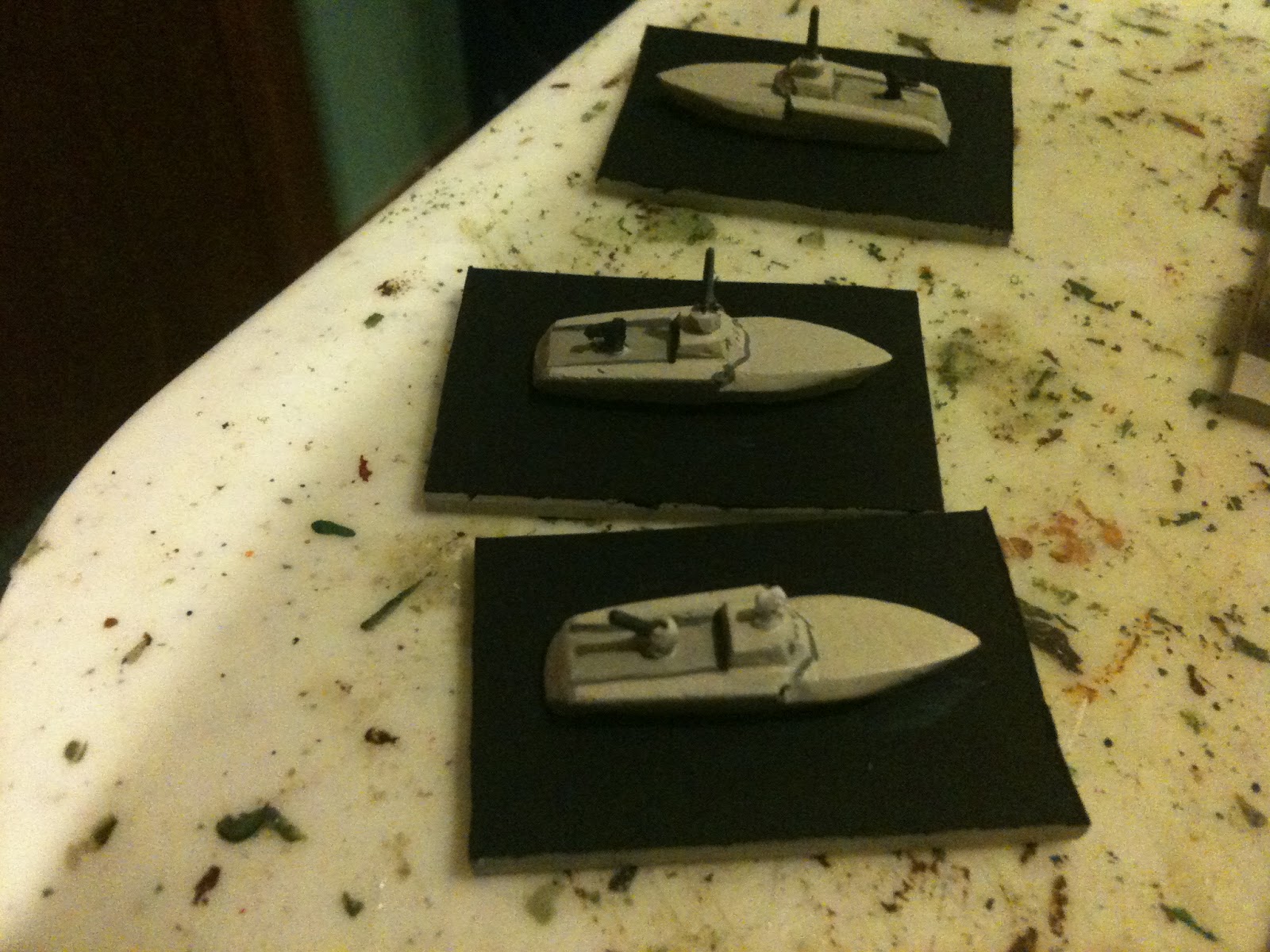
I finished up my PT Dockyard vessels this morning.  These are pictures of the vessels.  I have several more that I've already painted and I'm tempted to redo them to match the color and detailing.  I must say I like these much better.  The smallest vessels, the Boghammers are new castings and much superior to the old ones.
Thondar missile boats are among the nastiest of the Iranian vessels. Chinese built with Chinese missiles

Comparison shot with my original model.  It's getting a face lift.

Four "China Cats", another Chinese missile boat with a catamaran hull.

The last picture is the LCS-1 Freedom by PT. Dockyards.  As you can see, it is a much larger miniature than the Iranian vessels.  It will feature prominently in our Straits of Hormuz game.  Hope to have it finished Sunday. However in doing research for the detailing, which will have to be painted in, I've discovered I need to re-paint the hull that same USN brownish gray I primed the model with.  I've included a couple of pictures of a finished model that inspired my thinking, as well as as photos from the U.S. navy that show the contrasting grays.  Not a big deal.  Will probably lose about a half hour in painting and touch up.
Boghammers.  The first three are the new models.  The outside two are the old miniatures. 

Tir torpedo boats
US Navy photos of LCS-1 Freedom clearly show the upper works a lighter gray than the Gull Gray hull. 

USS Freedom (LCS-1) is a work in progress.  There is a Thondar below and a Boghammer above as a size comparison.

That same USN gray is clearly visible in this photo of LCS-2 Independence.  My miniature of this vessel is a styrene model kit by Dragon.  I'll be spray painting this vessel because I smell disaster when I think of using brush acrylics on a mini this big made of styrene.  A big bunch of bad.
LCS-2 Independence with its distinct trimaran shape and gull gray coloring.


Wednesday, April 25, 2012

PT Dockyards and the Straits of Hormuz

Side view of Iranian Thondar class missile boat. 

I have a lot of resin coastal vessels from PT Dockyards.  David Gregory runs a fine niche business.  Though PT Dockyards vessels take some work (and I don't work hard enough on them) I like them better than the metals from Skytrex.  Though they have the virtue of being metal, and the detail is sometimes a bit finer, the Skytrex WWII coastals and moderns seem just a little too large and solid.  And when they have flaws they really stick out.  I generally feel PT's flaws can be massaged a bit and hidden.  I do kind of wish David would go with photo-etched guns and fiddly bits which would raise the price considerably, but they would be a bit tidier than digging them out of the resin "wafer."

Daveshoe and I are working on our piles of Iranian vessels for our Straits of Hormuz game at Enfilade.  The game allows the Iranian player to select from a large number of vessel types.  Small vessels to be sure, from the speedy Boghammers armed with multiple rocket launchers, RPG's and automatic weapons, to the nasty Thondar missile boats with Chinese anti ship missiles and automatic cannon.
Nearly completed Thondar class.  My little kits didn't have complete auto-cannon, so comparison with picture may be weird. Mounted on 2 1/2 inch bases.
Boghammer fast patrol boats with China Cat missile boats in background.  Mounted on one inch square bases.
Tir stealthy torpedo boats on 1 1/2 inch bases.  Minis are done, but bases aren't finished.
I'm always at a loss when it comes to painting these little ships.  Though there are lots of photographs and even some nice color line drawings of the Iranian Navy and Revolutionary Guard Navy (the most likely early combatants in the Strait,) getting a workable paint scheme going can be a challenge.  I started with a simple spray coat of Testor's USN light gray-available at Michaels.  Then I dug deep into my paint drawers and managed to pull out some Floquil Polly S paints that still had legs.  This was great stuff, and that it is no longer available is a crime against hobbyists every where.  (Hear that Testors-fascist paint monopolists!!) I grabbed a Dark Ghost Gray and IJN Light gray.  Combined with Vallejo Neutral Gray for the decks, I had colors for my Iranian fleet. 

As you can see the vessels are all assembled and most are in various stages of painting.  I'm hoping to have them finished by the weekend and will update this post.  As I said, this is for Enfilade, and when they are done, I'll have only two large American vessels to complete for the convention.

Monday, April 23, 2012

The Chickasaw Bluffs playtest

The Chickasaw Bluffs playtest finally happened. Sort of. No it really did.  I say sort of because on Friday I had an epiphany.  The original plan for the scenario was basically a game on a 10' X 8' table or two 5' X 8' separated by walking space between the two halves.  On one half an American amphibious assault landing aimed at capturing a Spanish battery overlooking the Mississippi.  On the other half a punitive expedition against Spain's Chickasaw allies.  On Friday I determined running both actions simultaneously would be at least a monumental headache, if not a disaster, so I decided to split them into separate scenarios and separate game periods. 

Yesterday Al Rivers, Steve Ghan, Dale Mickel, Gary Griess, David Sullivan and Lawrence Bateman got together at Game Matrix and played  the "Just a Big Indian Fight" scenario.  The Americans, tasked with capturing or destroying the Chickasaw village had one company of militia composed of four ten figure squads. The Americans also had two six pounders.   They also had two companies of regular infantry composed of three twelve man squads.  They were opposed by three warbands of Chickasaws, each composed of three ten man squads.
American troops advancing to the creek.  Militia is in the foreground and about to be roughly handled by the Indians

All seems quiet in the Chickasaw village

Lawrence Bateman's command advancing across the river.

Lawrence has already taken fire and dispatched one band of Chickasaw to his front.  More to his right front.

The Indians set up in cover, and with the exception of one unit of Indians, the Americans contented themselves with crossing the little creek flowing across the board.  The militia stumbled into an Indian ambush and quickly found itself outmatched when the Chickasaw took to the tomahawk and war club.  Two squads were annihilated and the rest were driven back across the creek. 

Dale's regulars did a slow dance with the one advanced Indian unit visible on the left, but the American regulars showed themselves to be formidable, advancing methodically on the left and in the center, using their superior command ability to their advantage.  Eventually they advanced toward the cornfield where David's Indians dosed them with fire and charged.  Formed troops with bayonets proved not nearly so brittle as the militia, and they gave at least as good as they got in melee. One of the regular squads was eliminated in the advance, but eventually David's Indians were cleared. 

On the right, Al's Indians continued to be difficult as Gary regrouped his Indians.  Steve's remaining bands retired from the cornfield to the safety of the fort, while Lawrence and Dale advanced with their regulars and began burning the cornfield.  It's a slow process, and required a bit of good luck to make rapid progress, but eventually the victory points began piling in.  When Lawrence worked a squad into the village and burned one of the houses, we called it a game. 

No playtest is ever perfect, but it seemed to go well.  We discussed some simple tweaks and an option for the Indians, but nothing major.  We played just over three hours and seemed to reach a conclusion. 

Wednesday, April 11, 2012

Chickasaw Bluffs: River assault boats

Boat 1 with 6 pound boat gun.  Strictly gunfire support material
Yes, it's been a while since my last post.  I'm truly sorry.  I seem to have hit some sort of blogger wall.  It's not that I'm doing nothing, I'm painting almost every night.  I haven't been playing many games and that does lighten the number of posts I can make, unless I devote myself to boring navel gazing.

A look further astern.  That's a Lewis and Clark figure on the stern.  Makes a good squad leader.
I'm still working on units for Chickasaw Bluffs and I'm nearly done with them. I sixty Perry militia figures and I'm down to the last twenty to wrap up.  I'd hoped to have them done over Spring Break last week, but no such luck.  Soon.  Unfortunately, tomorrow I leave for the National Student Journalism convention.  This year it's just up the road in Seattle, so I don't lose a day to travel.

A nice shot down the stem of the boat.
While I was doing some tedious blacklining on my figures I decided to take a break and paint up a couple of the small boats needed for my river landing at Chickasaw Bluffs.  I'm using four of the Merrimac shipyards boats.  These come two to a box.  I bought them about four years ago as a member of the Old Glory Army.  They were very inexpensive, I wanna say ten dollars for two with the discount.  The boats come with a ton of goodies-oars and oarlocks, boat howitzers and swivel guns.  A great value for the price.

A shot at boat two with the three swivels

I chose to make the swivel guns of iron rather than brass.  Thought that might be more the norm on the frontier.
 For the game, these are simply assault vessels, landing craft.  They'll join the keelboat and my two Lewis and Clark as landing craft, dropping troops on to the shore.  I decided to army these two vessels differently, going for a 6 lb. boat gun on one with a bunch of blunderbuss armed swivels on the other. I just added some masts out of plastruct and away we go.
A quick comparison shot of the two boats.

Saturday, March 24, 2012

The Chickasaw Bluffs terrain bits appearing together


I thought about trying to lay out my Chickasaw Bluffs game on my game table, er, my dining room table.  There is one serious defect in this plan--my dining room table is much, much smaller than the 8' X 5' table I'll be working with next Saturday.  So, through out my cornfields and my palisade and my houses, just so's I could show them off together.  I'm actually really pleased with all of the pieces together and separately.  They're handmade, they cost very little, and, most importantly, they are finished.

Mark Waddington graciously sent me his Brother Against Brother rules, and I've been reading and tinkering with them.  I cannot thank him enough; he's a great friend.

Tuesday, March 20, 2012

When too much is too much

If you happen to see my copy of these rules floatin' around, please drop me a line.
Last Saturday I was supposed to host a playtest of my Chickasaw Bluffs game at the Game Matrix.  Because I am frequently forgetful, I always start laying out everything I need for my games a couple of days early.  Figures, check. Terrain bits, check.  Rules and scenario information, erm, shit!!. I almost always write up scenario details in the day or so before a game, but I usually need the rules to help me with it. 

Brother Against Brother is the rules I will use with Chickasaw Bluffs.  Unfortunately, my set has gone missing.  I tore apart my den, went through my boxes of figures, couldn't find them.  Friday, I swallowed my embarassment and canceled my game.  The rules, of course, were last printed in 2008 and are nowhere to be found, but my friend Mark Waddington has offered to provide me with his.  I've rescheduled the game for the 31st. 

Like many gamers, I have a lot of stuff. I don't intend to list all the miniatures I have, but it's probably 5-10,000 painted miniatures for lots of historical and fantasy periods in 6mm, 15mm and 28mm. To go with that I have many terrain pieces, including table sized (and table plus sized) felts, rivers, roads, buildings, etc. I have a couple hundred painted aircraft, 70 or so painted ACW ships.  Then there is all the unpainted lead-again, more than I'd like to count, the books and rules sets-you're a gamer you know what I'm talking about.  It's a lot of stuff. 

I like to think of this as fairly well-managed, but part of my problem is I live in a relatively small house, with limited storage space.  The space I have is full and there is not likely to be more.  I have a ton of stuff I don't use-rules I bought and looked at, maybe even tried and decided, these are not the ones. I am not a magazine person, but somehow I've managed to acquire buckets of mags--Campaigns and Tradition, the Courier, MWAN, Miniature Wargraming and Wargames Illustrated. In addition I have terrain pieces that have never left their boxes, unbuilt ships from Merrimack Shipyards, a pile of non-necessaries. 

With all this pointless chaff taking up space, it's easy to misplace the important stuff.  Losing my BaB rules is not the first important set I've lost.  I use a handful of rules sets:  Regimental Fire and Fury, Medieval Tactica Siege, The Sword and the Flame, Action Stations, and a few sets of home grown rules.  Why do I have five sets of AWI rules I gave up on years ago?  While I'm a sucker for nostalgia, my life would simply be better if I did a big purge and parted with the rest in the Enfilade Bring and Buy.

Tuesday, March 13, 2012

Field trip to Card Kingdom and Cafe Mox

Dave Schueler suggested we visit a board game shop in Ballard last summer, Card Kingdom on Leary Way.  After batting the idea to and fro over the months, we finally agreed on last Saturday.  I picked up Dave and son Casey in West Seattle and we arrived at the shop about 11:00 AM.  Our timing was perfect.  There was dedicated parking across the street. 

We walked in the door and things were just getting started.  We did a lot of looking.  Card Kingdom has lots of games, but nothing terribly hardcore historical.  Lots of Eurogames, lots of card systems.  They even had a nice selection of Games Workshop miniatures, Reaper paints and brushes.  There wasn't anything that really lured me in, but great stuff to look at.

There are some real amenities Card Kingdom offers.  First, they have a really nice tournament space.  Nobody seemed to be using it on Saturday, and it seems best set up for card games--though I think it would also work well for DBA.  They also offer some very comfortable private game spaces.  I'm not sure what the cost of using the space would be, but it was quite nice for a group of 6-8 playing board games.

Card Kingdom has joined another game shop in the area, Blue Highway Games on Magnolia Hill in Seattle, that offers a game library.  Want to try out a game, just borrow it and play it--in the little cafe that's basically part of the store.  Whoa.  Cafe Mox is not fast food, nor is it a dive.  Very nice place, awesome sandwiches, and they have micro-brews and wine.  I had  a vegetarian sandwich, but Dave had a great looking Caesar chicken wrap, and Casey had your basic grilled cheese.  The prices were reasonable. Cafe Mox is a great stop whether you're gaming or just grabbing coffee or lunch.

We set up Revolution! by Steve Jackson Games and played around lunch.  We enjoyed it.  The game requires you to build support for your faction in a town during a revolution.  The rules were easy and in a relatively close game, Casey won.  When we left the cafe to return the game, every table was full of games and gamers.  There was some kind of Warhammerish tournament going on (everybody used unpainted and semi-painted figures--ick!)

We left at about 2:00 and I dropped off Dave and Casey and headed for home about 2:30.  It was a great trip I hope to make again.

Wednesday, March 07, 2012

Chickasaw Village WIP

I'm moving ahead toward the first playtest of my Chickasaw Bluffs game on March 17th.  Yes, St. Patrick's Day.  I'm likely to lose a lot of good gamers to the suds that day.  In any case, I'm interested in focusing on the American attack on the Chickasaw village for that game.  I need a lot of terrain bits.  Some, like the Chickasaw fort and the big cornfield are done.  I've got a bunch of trees I'm working on, but I really need some houses for the village.
I decided to do the best I could building the Chickasaw summer house.  Note the planking and the open door and eaves that kept it cool during the sweaty Mississippi and Louisiana summers.

I just didn't think I could pull off the round winter dwellings.
I have some beautiful long houses by Acheson Creations.  Unfortunately the Chickasaw didn't live in long houses.  In looking at a few pictures, they lived in a couple of different types of buildings, different for the summer and winter.  The winter houses are round with circular thatched roofs.  I thought carefully about these and gave up the idea.  I just thought they'd be a mess.  Too many circles.

During the summer they lived in plank houses with thatched roofs, the houses cooled with open eaves.  I kind of dorked around with concepts.  I thought I'd build a frame with 1/8 inch dowels and use bass wood strips to do the planking.  I tried making a fairly busy frame, but I just couldn't make it work very well.  Instead, I built a simple skeleton using the dowels and drilling them into a chunk of craft plywood.  I bought a 12 inch square by 1/8 inch piece of craft plywood at JoAnn Fabrics.  I bought my doweling there, as well as strips of 24" X 1/8" X 1/16" bass wood.  I cut the dowels into lengths of 2" and 2 1/2 "  The 2" dowels would form the frame skeleton of the outside walls, while the longer dowels became the roof supports.

I stared by drilling the holes to sink the dowels.  I had to use my big ol' cordless drill, because my Dremel tool can't sink 1/8" holes.  After drilling all the holes I glued in my dowels.

Then I took my basswood strips, measured off 2" lengths and cut them with my scroll saw.  They are quite thin and fragile so it's important to hold them carefully from both ends.

I was really at a loss as to how I might glue my planks together.  I finally began gluing them to the plywood base and to each other.  The first building actually went together quite well and the planks were very uniform with no gaps and no major leaning episodes.  I can tell you, as I assemble, the rest of the houses (there are four), that it hasn't been quite so tidy. 

After all the planking was completed, leaving a gap for the door, I used my Dremel tool to sand down the uneven plank lengths to even or pretty close. 

My last challenge was to come up with something for a thatched roof.  I was really at a loss.  I considered using Woodland Scenics Field Grass over a tagboard roof.  The Chickasaw used a fairly sharply pitched roof that would lend itself to a lot of detailing and would take a long time.  Also, with Field Grass spendy at $4.49 a bag, it would add a lot to the cost.  While I was at JoAnn's I ran across a sale item, an off season planter liner.  I thought it would be cheap, would suit the purpose and look pretty good.  I couldn't reproduce the nice pitch of the roof, however, it's easily removed and replaced, and seems to do the trick.

At this point, I've finished one of the buildings, but should be finished with the remaining three by tomorrow night.  It's really taken three days of hard work.  After I finish the buildings, I'll need to figure out how I want to finish the wood pieces and complete the landscaping.  The finishing up may not be completed in time for my March 17th game, and the houses will have to appear naked (oh my!)

Wednesday, February 29, 2012

New Osprey: The Fall of English France 1449-53

Ever wonder how the English managed to lose the Hundred Years War?  I mean there's all those wretched French defeats at Crecy, Poitiers, and Agincourt.  French soldiers drown at Sluys and are shot to pieces at the less well known Verneuilles.  Why don't those silly Frenchmen speak English and eat bangers and mash instead of snails?
In his last Osprey Campaigns book on the Battle of Orleans in 1430, David Nicolle began to tell the story of how the tide began to turn against the English in France.  Nicolle wraps up the story of the English in France with this volume.  Nicolle primarily focuses on the Battle of Formigny and the fall of Normandy in 1450, and the collapse of English Gascony after the battle of Castillon in 1453. Nicolle has a fine narrative style and tells the story well, within the constraints of his limited space.  Would love to see an accompanying Men-at-Arms book on the evolution of the French army from a feudal force to a royal army, with emphasis on the development of the Bureaus' mobile artillery arm.

The book is good and useful for the wargamer for a number of reasons.  To the degree possible, Nicolle provides details about forces present.  There are a few good color plates of the battles, but not a lot. There are accounts of the battles and maps as well.  There are also a lot of contemporary photos of the location, some in color, which are nice if one is able to visit the battlefields.

If I have a complaint, it isn't the diminishing number of color plates in the Campaign series, it is the maps.  They are much better at showing movements of bodies of troops, rather than showing the battlefield itself.  Both Formigny and Castillon are relatively small.  The former likely had less than 5,000 men total.  Why not a battlefield map rather than a campaign map which really shows very little.

Sunday, January 29, 2012

Chickasaw Fort Complete

Front view. I used Woodland Scenics Deciduous foliage and their clump bushes. I also added coarse turf in places.  Affixed with Woodland Scenics Hob e Tac.

Same view from above.  As you can see the palings aren't perfect.  The cost, about four bucks, however, was.

A top view.  I feel I got a nice mix of green area and bare earth. 

A back view.
I finished landscaping the Chickasaw Fort on Thursday, but am just getting around to pictures today.  I'm really pleased with the way this turned out, even if the landscaping just sort of looks stuck on.  I still have more scratchbuilding to do for Mississippi.  The houses and grain storage is next on my list, but probably not something I'll take on immediately.

Saturday, January 28, 2012

Treading cautiously: modern naval war in the Straits of Hormuz

I've written about Dave Schueler many times in the past.  He is a good friend and a great gamer.  Daveshoe recently had one of his board games, U-Boat Leader on submarine warfare published, and that is huge news.  Congrats to him.  He is also one of my favorite co-conspirators.  We got to know each other well through our early dabblings with the WWII air game Mustangs, our work on the Golden Age Air Racing, Thunderboats and many other naval and air projects. Dave is a great teammate, he understands game systems, and there is no better designer of scenarios.
Cyber-Hobby LCS-4 is a highly detailed 1/700 model of a mine warfare version of the U.S. Navy's Littoral Combat Ship
In any case, Dave and I have been chatting up an Enfilade naval scenario.  We originally thought we'd rerun a WWII naval game we'd hosted at ConQuest several years ago.   We've been reconsidering this, however as the crisis with Iran becomes ever more topical.  While we've done an interesting Strait of Hormuz game in the past, we're considering another.  With the new Littoral Combat Ships entering service and miniatures available from P.T. Dockyard and Cyber-hobby models, the period is available to be gamed.  We'll offer a menu of ship choices to the United States and probably a combination of Revolutionary Guard and Iranian Navy vessels to the Iranian players.  There will likely be objectives beyond reducing one or the other side to splinters.
Throndor class missile boat test firing new Iranian missile
Frankly, I find the entire Iran/Straits issue quite troubling.  By the time of Enfilade, the advanced sanctions and potential boycott of Iranian oil will be nearing implementation by the European Union and the United States.  Threats of war and rising tensions between the U.S. and Iran are likely to be regular features in the print and electronic media.  Is this a topic we should avoid for a convention game, or is a good game just a good game?