Thursday, October 27, 2011

My Mississippi Project: Defending the Spanish Border


In 1783 the United States and Spain were allies, two of the signatories of the Treaty of Paris that ended the American Revolution.  The United States won its independence and  the vast lands west of the Appalachians to the Mississippi River.  If they could wrest them from their Indian inhabitants.  Spain won the Floridas from Britain, together with its port of Pensacola.  If they could stave off their weak but potentially dynamic young ally.
The Louisiana Regiment was  one of the few regular Spanish formations in North America.

Fast forward 15 years. By 1797 thousands of settlers poured over the Appalachians into Kentucky and Tennessee.  The American army, through stumbles and disasters, conquered a peace with the Indians.  Productive farms in the Ohio valley, unable to get their goods over the Appalachians sent it by flatboat to the Mississippi and from there to New Orleans, where it was sold or trans-shipped to the Atlantic coast or Europe.   Or not.

The stumbling block was Spain.  The Spanish controlled New Orleans, the Floridas and Mexico.  They were determined to keep the Americans, rapidly expanding west, out of Spanish territory.  To do that they established military posts on the west side of the Mississippi, established posts at Natchez and Chickasaw Bluffs on the east side of the Mississippi (against the terms of the Treaty of Paris) and made peace overtures to the powerful Chickasaw and Choctaw Indians in the Mississippi, Louisiana and Alabama regions. They put oared gondolas on the Great River with orders to inspect and obstruct traffic headed to New Orleans.
Chickasaw warrior.  The Spanish made alliance with many native tribes to deter invasion by the Americans.
The Spanish empire bordering American territory was enormous.  To garrison it, the Spanish depended on a few European troops augmented by colonial militias.  The system of presidios, or military posts, was systematized in New Spain by the 1770's as was the number of cuera or presidial militia.  These soldiers were intended largely to defend the frontier from Louisiana to New Mexico, chiefly against Apache and Comanche indian attacks.  Armed with the escopeta, a short musket or shotgun, sword, lance and shield, they were deemed to be effective against clubs, lances and arrows wielded by indigenous warriors. Their clothing featured a knee length leather vest, heavy enough to turn aside many of these weapons, much like the buff coats worn by Cromwell's Ironsides. As more of the indians were armed with trade muskets from English traders, they posed a greater challenge for the cuera.

In order to maximize their troop strength to deal wit a potential American conflict the Spanish made alliances with various Indian tribes.  In order to preserve approaches to New Orleans, the Spanish enlisted the aid of Chickasaw warriors.  To the west, the Spanish were on friendly terms with the Comanches, and included some of their number in the expedition to intercept Lewis and Clark.
Traditional Cuera soldier that served in the Spanish borderlands.  This  illustration  shows  the subject with lance, shield and musket.  He is equipped with a thigh-length leather jacket. 

Tuesday, October 25, 2011

'These wounds I had on Crispian's day.'

Today is the feast of St. Crispins, the anniversary of the Battle of Agincourt is 1414.  For those of us who cherish the Hundred Years War, it is a day to be remembered.  I can honestly say (and I have several times on this blog) that John Keegan's account of the battle in The Face of Battle remains one of my most important motivators to continue in miniature gaming and particularly the Hundred Years War. 

Of course another important motivator was the fine Kenneth Branagh movie version of Henry V.  The stirring St. Crispin's Day speech remains one of the finest monologues in all of Shakespeare.  You can find it here.

Saturday, October 15, 2011

My Mississippi Project: American Service Dress 1792-1807


My Mississippi Project took a brief detour as I took a couple of weeks to work on figures for an upcoming Martian game. Before my trip to Mars however, I painted the fifteen unpainted Wayne's Legion figures I still had hanging around.  For some reason, I thought I had more, but no such luck.  I looked everywhere and dope-slapped myself when I realized I'd painted some of them for War of 1812 Virginia militia.  Doh!
Old Glory Wayne's Legion Line skirmishing.  Quite serviceable figures though the necks often seem a bit too long.  Posing with muskets is also a bit dicey.

A few of these figures sport the blue wool winter service trousers.  They would serve well as American infantry from 1792-1810

One might wonder why the heck Virginia militia would be dressed similar to Wayne's Legion, whose uniforms were designed in 1792.  The fact of the matter is that American uniforms changed very little from the Battle of Fallen Timbers in 1794 up until the eve of that other great Indian fight nobody knows anything about, the Battle of Tippecanoe in 1811.

Though the uniform went through several permutations, the uniform of the period was adopted with Congressional authorization of the Legion of the United States in 1792. Built on the wreckage of the army butchered at the Battle of the Wabash, the Legion was composed of four sub-units, each of 1,280 composed of dragoons, artillery, light infantry, and line troops.  Wearing a distinctive round hat with bearskin crest, each of the four sub-legions wore red facings, but distinctive markings-a colored hat band and plume.
1792 Regulation Uniforms.  Note the colored plume and hat band of the sub-legion.  They would be gone with the passing of the Legion.  Note the knee length coat. Charles McBarron illustration
After the victory at Fallen Timbers in 1794 and the triumphant Treaty of Greenville in 1795, Congress downsized the army and eliminated the Legion, reducing the army from 5,120 to 3,000 troops, discarding the light troops and forming the remainder into four regiments.  These regiments dressed alike with red facing and those troops wearing white bearskin crests changed to dark crests.

Though the uniform went through the minor changes, such as the addition or subtraction of lace here and there, and the lengthening and shortening of uniform coats allowing turnbacks or not, the United States infantry changed its dress very little.  The round hat with bearskin crest became the standard headdress for infantry and artillery, with the cavalry wearing a Tarleton helmet.
Later dress.  The infantryman wears blue trousers as part of his winter dress.  The green dragoon uniform is evident.  From MAA 352 by James Kochan and David Rickman.
There was one major  change during this time and that was for dragoons.  In 1799 they adopted green uniforms, mostly through the work of a contractor waiting on authorization from the War Department.  In 1801, the dragoons were unhorsed and became foot soldiers unless mounted troops were required.  A cost saving measure.  In 1808 the dragoons received another new uniform, this time blue with white trim and a helmet similar to those worn in the War of 1812.

In 1810, with the country preparing for war, the infantry received altogether new uniforms, one familiar to War of 1812 buffs.  They would see use in the victory at Tippecanoe and the embarrassment of Queenston Heights.

Thursday, October 06, 2011

Making the Most of My In Service Days: Thursday Live Blog

It's darned early, 5:03 AM.  I have today off, courtesy of my principal, the much revered Brian Lowney and the Puyallup School District.  October 6th and 7th are district and state in-service days.  In the old days we had these days off to participate in teacher trainings offered by districts state wide.  Now they're pretty much used for catching up or taking a break after the first month of school.

I plan to use my day mostly for painting little men, so I'll keep you posted throughout the day on what I get done.  Warning*: this will be live blogging, little snippets of info, hopefully accompanied by pictures as the day goes along.  It will also be largely unfiltered.  I'll mix in various other activities as the day goes along.

5:10 My day begins with our pets.  15 year old cat Daphne, mini-Australian shepherds Jack and Lucy, nine and ten respectively get fed and then I take the dogs for a walk.  Nothing long, about 15 minutes in our development.  It's been pissing rain the last 24 hours, but I managed to get them out in between most of the raindrops.  It's dark, so picture taking is out (besides my iPhone is charging and my pics will be with my phone today. Probably.) After we get back and dried off a bit, I'll settle in to read and maybe a nap until Lorri heads off to work at7:00.  I've been a bad sleeper for a number of years now and the best I can manage is 6 1/2 or so hours per night.  Last night was worse than usual.  Pretty wakeful after 2:30 and wide awake at 4:00.  Definitely a nap in the cards.

For now I'm going to read An Artist in Treason by Andro Linklater .  It's a biography of James Wilkinson, general in the American Army during the Revolutionary War, but more importantly in the period from 1784-1813 or so.  It is a 2009 biography about one of the most extraordinary rascals in American history, and covers the era of my Mississippi project.  It's a very accessible work about Wilkinson's role as a spy for the Spanish during this critical era.

7:25 Emerged from the shower to howls of protest from Daphne, the dogs had their daily savaging of her food from her dish.

Today I have two chief goals.  The first is to finish basing the Space 1889 Martian swordsmen and Wayne's Legion figures I have on my desk.  You can see them here.  I used wood putty on their washers and Litko bases respectively as build-up.  Shouldn't be a big job.  I'll write more about them later.  The Wayne's Legion figures are from Old Glory's range.  Serviceable despite some errors.  The Martians are from RAFM.

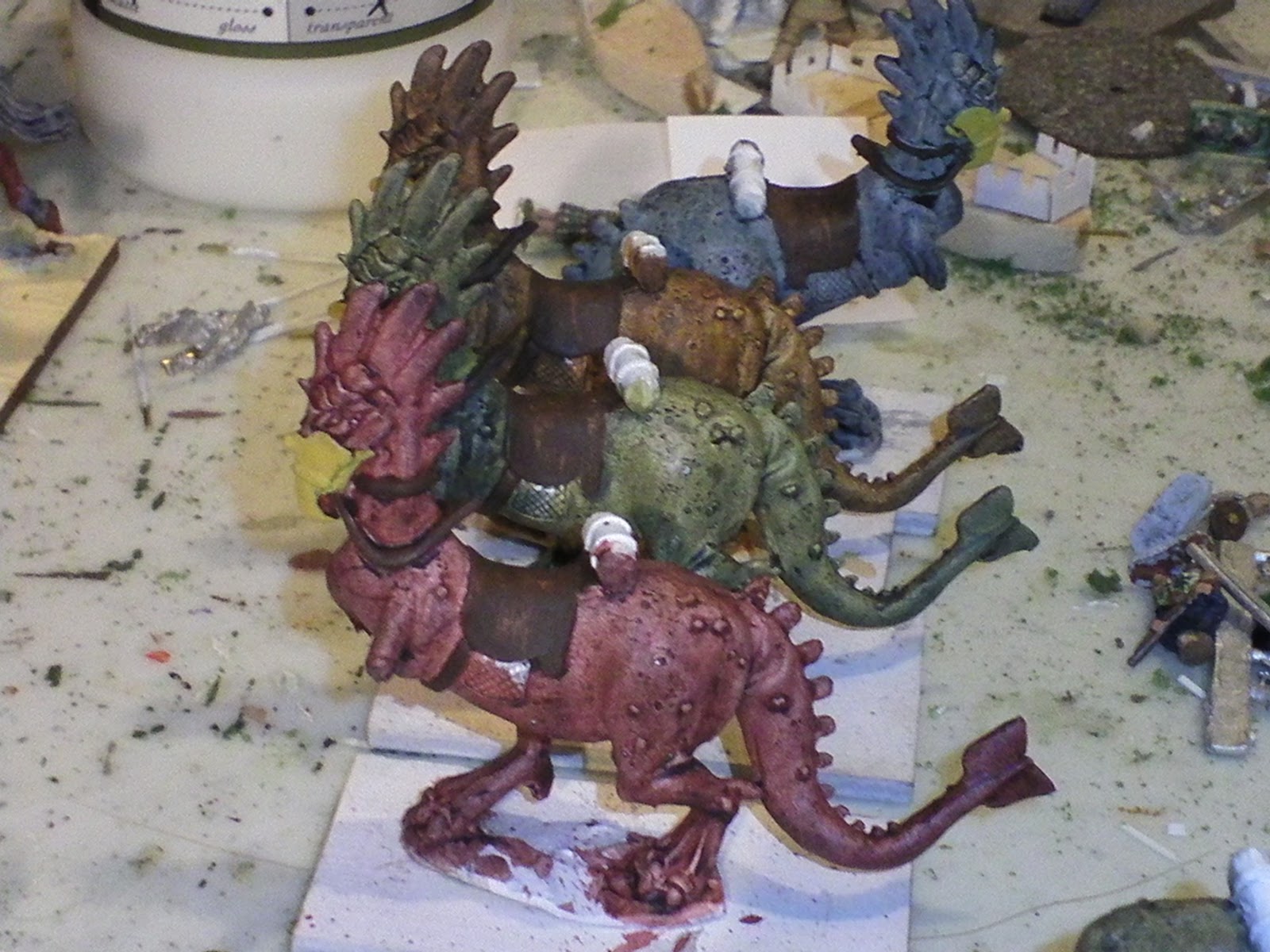
I also want to finish painting the big critters. These are Gashants, riding beasts of Mars, again from RAFM.  I really like this particular version of the Gashant.  They appear large and fierce.  They are the mounts for some Martian native light horse, er, native light gashant, um, irregular mounted forces.

10:10  I'm off to run some errands--library and a haircut.  Worked on my Gashants while watching Khartoum.  Definitely one of my favorite movies.  I worked hard to even out the color on the critters.  They've been washed at least three times now.  First with a lighter color, then a darker shade of the base color, then with a black wash.  Started on the horse furniture, er you know what I mean.

2:00 Got back from my errands had some lunch and plugged in The Outlaw Josey Wales.  Probably my favorite Western and definitely my favorite Eastwood.   I've worked for about an hour adding details to the Gashants.  Painted their beaks, saddles and reins, their head armor in addition to blanket rolls and strapping.  Probably another hour's worth of work to go.  Unfortunately I have to take a break to make the dog's food (long story,) and clean up the kitchen. 

5:05 I've finished the Gashants and the basing for the Martian swordsmen.  I'm getting dinner ready which will keep me busy for a while.  

 8:30  Finished basing all the figures, and I'm probably ready to call it a night.  Maybe read for a bit, and check back in with finished figures tomorrow.

Saturday, October 01, 2011

Useful Blogs--or at least I think so.

I have a couple of blogs I'd like to plug.  First is the Quindia Studios blog by Clarence Harrison.  Harrison has great pics of his work, and keeps us up to date on his League of Augsburg project.  But I confess I got there for only one reason.  Flag Mondays. Each Monday Harrison posts a useful flag for the American War of Independence.  Though he has plans to do British flags, he's mostly sticking with American banners.  American flags are tough because little is know about them for certain.  He's created beautiful flags for those units he is certain about, as well as those he's hypothesized for.  He also has some gorgeous national banners.  Every Monday.  I've downloaded 21 of them, and now all I have to do is make use of them.
Clare Harrison's Stars and Stripes variants.
Another blog I've taken to following belongs to Doug Hamm.  I've written a little about Doug before.  He is my good friend from Surrey, B.C. who often prods me about my lack of blog posts.  Doug has recently introduced his own blog, Dots of Paint.  Doug is a wonderful painter, certainly the fastest painter I've ever known and he is a master of the black primer paint system.  He has some fabulous projects he's created--a mammoth War of 1812 collection, a very nice pile of figures for the First Jacobite Rebellion, some very nice French and Indian War figures and many other explorations in other periods.  I'm sure he'll have some interesting things to say and share. Yes the Battle of Smythville does seem to have borrowed my name, which I'll try to understand at a later date.
These aren't French Napoloeonics, they are Plauche's New Orleans militia battalion from the Battle of New Orleans.  Doug Hamm has cornered the market on War of 1812, the interesting and the uninteresting.

Monday, September 26, 2011

The Mississippi Project: the Why and Wherefores

I don't know if gamer friends understand me.  Sometimes I feel they think I choose projects just to see how weird I can be.  (Of course, I played Bruce Meyer's Jurassic Reich game, and there ain't much weirder than that.  Fun but weird.)  What usually draws me in is my interest in historical circumstances.  The Lewis and Clark project rose out of my interest in the expedition, but also that Spain actually did make an effort to intercept the Captains and their charges.  My latest project I'll simply call my Mississippi Project.  Again, another hypothetical conflict between the United States and Spain, but based very much on historical circumstances.

1794 map of the southern United States showing border with Spanish territories.  Spain rightly feared American encroachment in Spanish possessions, particularly an effort to wrest New Orleans from their control.
Between 1797 and 1807, U.S. and Spanish armies faced off several times over the official borders between the upstart, covetous Americans and the fading Spanish empire.  In several cases the U.S. government rushed elements of its tiny regular forces to enforce its claims.  At other times conflict could have been precipitated by frontier militias anxious to pry loose Spanish fingers from the Mississippi River chokepoint of New Orleans. The Burr Conspiracy of 1806 was just such a potential conflict. From Florida to Louisiana, from Texas to New Mexico (Spanish provinces, not states,) both sides provided ample provocations to raise the ire of the other.  The Lewis and Clark expedition and  Zebulon Pike's exploring party, both organized and equipped by the U.S. military, were considered tests that had to be met to sustain the Spanish empire in America at the same time the Americans extended their imperial aspirations across the continent.

This project will also weave together two other semi-projects.  When they first became available I bought some of the Old Glory Wayne's Legion figures and didn't really do much with them.  It didn't help that the light infantry figures were incorrect and I wasn't sold on Darryl Smith's Our Moccasins Trickled Blood rules.  Eventually I painted up some of the figures for Virginia militia in the War of 1812 and others for Lewis and Clark.  This project will allow me to paint all my remaining Wayne's Legion figures in the 1796 pattern uniform, but I'll also commit to playing all three periods.  I can do actions from the Fallen Timbers campaign, it keeps Lewis and Clark alive but no longer a one trick pony affair. And then there is the war of nerves between the U.S. and Spain in which American uniforms change drastically, but I'm not sweating it (and nobody makes them anyway

The really nice part of this project is that it's already partly completed.  The Spanish troops are all painted except for a pair of irregular cavalry units and some guns and gunners.  I do need to paint more Americans but not that many.  My Indians are all finished and desperate to be let out of their box. I would like to buy another 30 of the wonderful Perry Southern militia figures from their AWI range, but otherwise I own all the figs.

In posts that follow I'll share some of the troop types and provide pics of completed units.  I'll also share my ideas for a mini-campaign I have percolating, as well as sources in case something like this piques your own interest.

Sunday, September 25, 2011

Fix Bayonets: My first game of Sail and Steam Navies

Today was the second installment of Fix Bayonets.  Held at historic Fort Steilacoom, it's a nice little gathering at a great location.

I hosted a small ACW naval game using the Sail and Steam Navies rules I bought last month.  While I'd read the rules pretty thoroughly it was the first game I'd actually played.  I chose a scenario I'd run before with Ironclads featuring the large Union wooden vessels Niagara and Vanderbilt intercepting the Stonewall with wooden consorts in stormy conditions headed for Havana.
Confederate fleet enters the board, looking something like a hydroplane race.  From top:  Texas (Thoroughbred Alabama), Bat (Peter Pig blockade runner), Thoroughbred Stonewall, scratchbuilt blockade runner masquerading as Tuscaloosa after I left my actual miniature at home! Dopey me.
The Union squadron.  From top: scratchbuilt Niagara, Thoroughbred Kearsarge, and scratchbuilt Vanderbilt.  All scratchbuilt ships by Larry Enoch.

I hadn't counted on the small table (6' X 5'), which was kind of cozy for 1/600 scale, but due to the scenario conditions it worked out-visibility and movement were both reduced to 42"

There are some real advantages to S&SN.  The rules can be played off the ship cards and a one page quick sheet.  At least in theory.  The ship cards are color coded and are provided as part of the rules package that come in a 535 page .pdf on a CD-ROM.  The ships are rated throughout the war, so many have more than one card.  Because the game is basically played on the ship cards, it's important to have the capacity to print them out in color, which can be an expensive proposition.  I printed out the cards I needed and then laminated them with my handy home laminator.
This single exchange of broadsides between Tuscaloosa and Vanderbilt resulted in a magazine explosion and plunge to the bottom for the tiny Confederate ship.
Far in the background, the sloop Niagara is pounding the Texas to splinters, while the Kearsarge and Stonewall prepare for a one sided exchange.

Stonewall has sailed through her Union adversaries and isn't looking back.  On to Havana and victory.
The game itself is somewhat less important as I was trying to to get a handle on the rules and especially to see if the players liked them.   Nevertheless, a quick blow by blow is in order.  The Confederates entered the table somewhat the worse for wear due to storm damage.  The Stonewall, accompanied by the steamers Texas (freshly escaped from a French shipyard and fitted out in the Azores), the Tuscaloosa, and the blockade runner ran headlong into the open arms of the an American squadron searching for the French-built vessels.  The super-sloop Niagara, Cornelius Vanderbilt's armed steamship Vanderbilt, and the Kearsarge.
USS Kearsarge ignominiously ramming USS Vanderbilt.  Kearsarge, with her steering destroyed, had little choice in the matter.
 The game opened outside of the limited visibility, due to rain and fog.  Speed was reduced by 1/3, and gunnery suffered a minus due to high seas.  On turn two that changed as Niagara devastated Texas with her massive broadside.  Kearsarge and Niagara continued pounding Texas, while the diminutive Tuscaloosa tangled with the massive Vanderbilt.  Meanwhile Bat and Stonewall seemed to slip through the Union net.  Stonewall connected once with her massive 12 inch Armstrong rifle, tearing through Kearsarge, causing a boiler explosion, damaging steering and killing crew.  This bit of good fortune did not prevent Tuscaloosa from suffering a mortal magazine explosion after a one sided exchange with VanderbiltKearsarge, out of control, eventually collided with Vanderbilt, nearly sinking in the process, while Bat and Stonewall steamed for Havana--only to be interned and sold by the U.S. Navy.  Based on the scenario rules, the Confederates won.

I found the rules to be more playable than Ironclads without much loss of authenticity.  There are a couple of clarifications needed to some language-as with all rules. Everyone liked the simple order writing requirements.  Some differences in the game really did unbalance the game.  In Ironclads, Niagara's 150 pdr. Parrotts and 11 inch smoothbores would fire every other turn, as would Stonewall's Armstrong rifle.  In this game only monitor guns fire every other turn.  I truly don't have a problem with this but it made Niagara the grim reaper against wooden ships.  However, against armored Stonewall, hits pretty much pinged off with little opportunity to do serious damage. 

I'm anxious to try a bit more evenly balanced game in the near future.  I think Sail and Steam Navies is a winner.

Sunday, September 18, 2011

Do Overs

I don't know about you, but I'm contemplating re-painting some figures.  Twenty years ago I painted in a completely different style.  I was a paint stainer.  It was a style I learned from a friend of mine, Bill Stewart.  He was, and remains very good at it, is highly productive with this technique, and continues to produce lots of beautiful  figures with it.  I had some success with that technique, but I also produced some very light colored figures I no longer like, and I'm thinking about repainting them.
The two figures in the middle are painted for the Legion system in the Fallen Timbers campaign.  The two outside figures are in the later 1797 regulations.  The figure on the right is in the all-blue winter dress.
With the Jacobites and their enemies finished, I'm beginning work on my next project-my hypothetical war on the Mississippi River between the U.S. and Spain.  Many of the American figures will come from the Old Glory  Mad Anthony Wayne range.  I painted figures for the Fallen Timbers campaign many years ago, staining them.  Today my technique is more of a block color with highlighting way of painting.  I like it better because the colors look more, well, colorful.  I've include some of my old figures, along with some of my newer figures from my Lewis and Clark project as comparison. The other reason for re-painting was that the U.S. uniform regulations changed in 1796 with the reorganization of the Legion of the United States and the end of its odd color-coded style.  With the reorganization of the Legions into four regiments, the army retained many of the features of the previous uniform, but with simple red facings for all units, the colored bands on the round hat were eleminated, and everyone had a black bearskin crest on their headgear, rather than white for some.

These are the same uniforms the Lewis and Clark Expedition wore on dress occasions, and were in service from 1796-1804, and the figures could do double-duty for L and C and my Mississippi campaign.  So I'm likely going to do the repaint.  The alternative would be to buy more of the Anthony Wayne figures.  To be truthful, I have a lot of these figures painted, together with bazillions of OG Woodland Indians, but I've never played a game with them.  They've lived in their box for years!  That is a shame.  With lots of excitement about my project, which could become a nice weekend mini-campaign, I'm leaning toward the repaint.

I've also included a poll.  The question is would you consider re-painting some of your figures?

Saturday, September 17, 2011

Moving Along: Hallmark Jacobites finished.

Last night I finished painting flags for five units to put the finishing touches on my Hallmark Jacobites.
The Highland Army

This has been a difficult project to struggle through.  For one thing, I know little about the period-always a little dangerous-and was attracted more to the figures than anything else.  As I've said before, the entire range-Highlanders, League of August figures, and extensive baggage and fortifications-are very nice.  They never practiced the steroid induced figure creep of other 15mm ranges, but despite their small size retain considerable detail and character. 
Five of the English Battalions I've painted.  Mostly the Scots Brigade

The Scots Brigade with their commander

Militia Horse
The Highland center with Viscount Dundee

Right flank of the Highlanders
Left flank of the Highlanders.  Not super close, but you do get an idea of the figure quality
Attracted to the Battle of Killiecrankie, I acquired more figures than I needed, but painted them all anyway. About 375 figures total with most painted this summer.

For the Highlanders I have eight warbands.  In the rules we'll play King's War, they have no shooters and are superior melee troops. They also have the a single light gun, a small troop of horse and the Viscount Dundee.  The Scots are only allowed a single leader according to the special rules.

 The English have ten battalions including two Scots units in plaid and bonnets.  I painted the Scots Brigade from Holland-they're the ones with the cool flags.  In addition they have three light guns and two small units of militia horse. They have one mounted leader, a couple of dismounted commanders, and some grenadiers.

 I'm anxious to try out the rules to see if they work.  Written locally, the rules are really intended for the pike and shot era, but this may call for something a little more period specific.

Thursday, September 15, 2011

Logging Off TMP

I've been a member on The Miniatures Page since 2002, supporting and not supporting, but I've decided to part company with that forum.  Don't get me wrong, I believe it's a useful resource for our niche hobby, but times change, and so did TMP

The past few years have kept me busy and I've spent less time there with more commitments required to school.  However, there were more boards and more non-miniature related shenanigans going on which I found annoying.  Some of them I enjoyed-any talk about music or movies usually gets me blathering.  But there also seemed to be more of an edge to the posting, more needless nastiness that seemed unwarranted.  Sort of like American politics without the destruct button.

 The last straw for me, however was the harassment of a member through polls and in posts that I felt was completely unwarranted.  When the actions continued and reached their inevitable and ugly climax, I expressed my views in the forums and contacted the editor directly.  It was clear that this behavior of baiting and harassment was okay, and that was all I needed to be persuaded my time at TMP was over.

TMP wasn't always this way.  I've watched the editor ban others who were a pain.  I've seen him ban those who harassed him.  I've always believed him to be a fair and considerate person, but this latest issue leaves me with a different view. I've been a school teacher too long to condone such behavior with my support.  We're done here.

Note:  I've decided to backtrack on my decision to boycott TMP just a bit.  I have determined to post on blogs of war when I have something of significance to share, but I'm staying out of the forums.

Sunday, August 28, 2011

A Farewell to Summer

If you're an American teacher, this weekend means the end.  Beginning Monday I'll be back at school for a few days of workshops, and on Thursday students arrive whether I'm ready or not.  It's 8:00 Saturday morning and I'm busy counting up the things I need to do this weekend.  There's a deck to finish staining, some things inside to help Lorri with, a toolshed door to rebuild (ack, two toolshed doors to rebuild.) There's also the matter of doing some schoolwork to get ready for those 137 students I'll see on Thursday.  Bummer.
Dean's British riflemen, higlanders and a smattering of guerrillas march toward waylaying a French column.

French cavalary and voltigeurs waiting to be waylaid.
I'd like to lament the passage of summer vacation, but actually it's been enjoyable.  Not quite as much gaming as I'd like, but I've enjoyed the ones I've played.  Yesterday was our fourth and final Truant's game, unless those who are retired or have Fridays off choose to continue.  I didn't actually get to play.  We changed internet/phone/television carriers this week after ten years with Comcast, and the resulting snafus kept me too busy to actually play Dean's awesome looking Sharpe Practice game.  It looked nice and I have a couple of pictures, but I had to go.

 This morning I finished painting the last of the Hallmark British for the first Jacobite Wars.  I'll work on mounting them up this week and get some pictures posted as soon as they are done.  I have 30 gunners and British cavalry to paint to wrap up the project (except for the baggage which will come later.)  Another check mark on my things to do list.

After the Jacobites are done, it's on to the Mississippi.  I've begun assembling the Perry Hussars to make my Texas Hussars.  Very nice figures and a lot less fiddly than the Victrix Brits.  I also ordered some more of the Spanish militia types I used in my Lewis and Clark adventure- the soldados de cuera mounted as well as dismounted-and some Spanish artillery and gunners. I'm looking forward to something new, just like the coming school year.

Thursday, August 25, 2011

The Burlington Races--The War of 1812 on Lake Ontario

American fleet in their starting positions.  The cards by each ship note the movement order.  The Pike is the lead vessel
Last Friday we met for one of our Truants games.  Dave Schueler and Mark Waddington teamed up to play an age of sail game based on Jim Moulton's Prevailing Winds rules.  Mark Waddington shared his magnificent hand-made sailing vessels with nine players, none of whom had ever played the rules before.  This was a play test, so it was clear from the outset the game might have some rough edges.

First of all, it needs to be said, this game was a real gamble for the hosts. Not many of us play a lot of age of sail games, so we were easily confused.  The wind system was not difficult, but without hexes to visualize wind direction, it could occasionally be tricky but doable once I figured it out.  Movement was based on a card draw system that made things pretty random and difficult to stay in formation, and was my least favorite part of the game.  I thought gunnery was the easiest and best part of the game. The lack of familiarity with the rules led to some unnecessary crabbing, which was unfortunate.

 The War of 1812 lake battles are pretty interesting with some pretty unusual ship types.  First, they are generally smaller than we'd find in Napoleonic battles, with sloops, brigs and lots of small gunboats.  There is also the matter of armament as both side try to ship the biggest broadside for their small vessels.  Many vessels carry carronades instead of long guns to boost their broadside weights, but sacrifice gun range.  In our battle that was a problem as the Brits, with generally larger ships but few long guns faced a bigger fleet with more long guns.

I was an American player running the sloop Madison, following behind the American flagship Pike captained by Mark Waddington.  The Pike was armed with all long 24 pdrs., and simply ruled the lake.  As the British struggled to close the range, Pike easily dismasted the British flagship Wolfe, and had its way with a couple of the smaller British schooners.  Madison got off a couple shots with long guns, and fired off the carronades once as the British tried to close, but could not match Pike's hitting power.  Mark clearly had the most fun of the game.  The gunboats had their own little scrum going with a couple of the smaller British ships.  The British had a little more success fending of this mosquito fleet, sinking a couple of them and dismasting another.

I really enjoyed this game, and would love to play it again.  I only took one picture at the beginning, which doesn't do justice to either the game or Mark's beautiful ships.  Hand-made from balsa, with scribed decking, and handmade brass guns and gun carriages, they are simply magnificent.  I believe they are scaled at 1/600. We played with sixteen ships, and he had another eight or ten in his carrying case.

Sunday, August 14, 2011

Figures, Follies and Foolery

It's August 14th and back to school is just around the corner.  My summer game plans have not gone well. I just haven't been able to do as much as I hoped.  First, I'd like to offer my litany of excuses.  Come on, Congress had the debt ceiling fiasco, we're entering a political campaign season, everyone's handing out excuses, it's only fair I share some of my own.
Hallmark English regiment nearly complete
Three partly completed regiments.  I have these four pictured units left to complete.  Would love to be done with them by Friday August 19th.
First, I made some painting plans for the summer.  They were to finish my 15mm Hallmark Jacobite project and move on to my interesting 1797 hypothetical war in Mississippi project. Let's just say I haven't gotten as far as I'd like.  I ended up having a lot more British troops to paint than I thought, in fact more than actually served in Scotland in 1689.  That's okay.  The fact of the matter is that I'm getting close to finished painting all 180 figures.  That still leaves cavalry, guns, gunners and various accoutrements to paint as well, but when they are done, they're done.  It's a finite, finished project.
Ahh, my messy painting table. One Hallmark unit finished, but not based. To the right are some Old Glory Wayne's Legion figures patiently waiting their turn in the painting queue.
While I haven't finished a damn figure for my Mississippi project, I am acquiring some new minis.  Many of the figures I'll use for scenarios for this project will be drawn from other activities.  Wayne's Legion figures and militia types from Lewis and Clark and Fallen Timbers;  Spanish figures from Lewis and Clark; Indians from Fallen Timbers.  However, using some birthday bucks and a bit of my stipend from my Ellensburg teaching gig I've ordered some new toys.  First, I ordered (and have received) a box o' Perry French Napoleonic hussars.  Remember this picture? Those figures, with their mirliton options, can be made with the Perry hussars by adding a round shield-the perfect accessory for catching Comanche arrows. Nice stuff, definitely less fiddly than the British Napoleonics I was assembling earlier this week.  I also ordered more of the soldados de cuera figures that London War Room produced.  They are now made by Dayton Painting Consortium.  While I've provided a link to their website, you won't find pics of the cuera soldados there.  I ordered enough figures to add one figure to each of my two existing units, and one more unit for a total of three.  In addition I added a mounted lance armed cuera unit to go with the hussars, and some guns. I'm kind of itching to work on these guys, but Jacobites first.
Boxes of figures!! The Victrix Brits I packed off to Ellensburg lie below the Perry Hussars I received for my birthday.  "Our day will come . . . "
 In terms of the follies, I announced the purchase of a new set of ACW naval rules a couple weeks ago.  I've watched patiently as the mail carrier has driven off each day without dropping off my long-sought rules.  Finally, Friday, after I had not received my rules, I called old friend David Sullivan because he said he had ordered them after reading my blog post.  He told me he'd received his order from Bay Area Yards.  Gah!! I went back to the Bay site, and still sitting in my shopping cart was my order.  I'd never actually sent it in. I, of course, immediately remedied that problem.  So Sail and Steam Navies should arrive soon, I hope.

 There is some upcoming foolery this week as Dave Schueler brings his naval game down to Game Matrix Friday for a truants game.  I believe this may be a Barbary Wars game, one of Dave's obsessions, and it should be fun.  This is more of a playtest than anything else as I know he's been searching for the right rules.  I'm really looking forward to it and will be sure to pass a report along.

Monday, August 08, 2011

Victrix Napoleonic British WIP

I'm over here at Central Washington University in beautiful Ellensburg.  I opted not to bring a laptop with me, know I have my iPhone and will have access off and on to a computer lab.  I'll have some down time so I opted to bring along a box of my cherished and well-buried Victrix Napoleonics.

A few years ago at Enfilade I spent some of my earnings from the bring and buy on a few of boxes of the newly released British, the flank and center company boxes.  I purchased these to form the British troops that fought in the Chesapeake region during the War of 1812.  You know, burning of Washington, rockets red glare, those British.  Unfortunately, they've lived quite happily in my garage, never saying a word, until I moved most of them into my painting room this spring.  They cheered a little.

This past Tuesday I opened a box of the little fellows and looked carefully at all the little men and all the little sprues of heads, backpacks, and arms and quickly put them back in the box and put them away.  I was scared.
The Victrix British come with eight sprues.  Four are mostly bodies with backpacks and heads.  The other four are full of fiddly bits-standards, half-pikes, muskets and arms. Don't be daunted.
A sprue of fiddly parts.  There are three more just like these.
This morning, while I packed, I stuffed a box of Victrix center companies into my handy messenger bag in the place my laptop would have gone. After checking in to my room early, I opened my box and looked at the sprues of bodies, arms, heads and equipment.  Oh my God, where to begin?  I eschewed my typical male response to reject the instructions.  The instructions have tons of information, including a rulebook. Most importantly they have a diagram showing how to make the various body styles with the multiplicity of arms, legs, head styles and equipment.
The assembly instructions.  Keep these around; they'll make your life easier.
After looking at the body styles, and all the bits that would be glued to them, I decided the best course of action was to cut out the full bodies and separate them into types.  There are four slightly different body styles for the privates.  There are drummer figures, nco figures and officer figures.  Be sure you have a sharp hobby knife, and remove all mold marks because fit is so important when it comes to gluing. I found all the parts to be relatively free of flash.
I sorted my miniatures into four groups-basic infantrymen, drummers, nco's and officers.
Once the figures were sorted, I decided to assemble the special figures first, and that is as far as I'll go with this entry.  I began with the drummers because they were the most distinct and with few options.  First I assembled the drums.  They come in two halves with a hole for the peg on the figure.  These halves fit together quite neatly, but they have to be wiggled around a bit to snap into place.  I used Zap CA glue to assemble my figures, but plastic cement might work better. After assembling the drums, I glued them on to the figures.  Mistake!  I encourage you to glue the arms on first, let them dry a bit, and then glue the drums on.  With drum on, there is much less room to fiddle with the left drum arm in particular.  The drum pose seems odd to me, the drumsticks seem to cross a bit too much, and I feel like the drummer is sending out some strange gang sign I don't understand. I also gave the drummers a knapsack and blanket roll.  There are some nice choices here.  Cut them out and clean them and you're ready to glue them on.  I encourage you to put your glue on the belting on the back because it's more likely to touch the knapsack than putting glue on the latter.
Completed drummers.  These weren't difficult to finish, but I encourage you to put the arms on first.
Next I chose heads to finish the figure off. There are a number of different head styles: the standard with shako plate and plume, shako with oilskin cover, and even bareheaded.  Gluing the heads on can be kind of tricky.  The heads fit very precisely.  Be patient and move the head around in that recessed collar until it snaps into place.  Be sure you've trimmed the neck properly.  I spent a lot of time picking heads off the floor


You can see the standard with its tassels in the middle of the photo.  Take care cutting it away from the sprue, though it was not as fragile as I feared.

Completed standard bearers.  The officers have their sashes to the right, the nco's are sashed to the left.
When the drummers were done I moved on to creating standard bearers.  Each box of mini comes with four nco's and four officers and I used these figures to make my standard bearers.  The standards themselves are quite nice, but they are spindly, and I always worried about snapping the flags poles or the tassels that come with them. These figures went together pretty easily.  The nco's have their sashes on the left (facing the figure) and the officers have their sashes on the right.

This left the remaining nco's and officers.  You can choose to create your sergeants with a musket or a half pike.  My choice was the latter in order to make them stand out.  Again, I was very cautious cutting the half pike out to avoid breakage. You also have a choice of right arms (facing the figure,) either across the body or at his side.  I chose the latter.  For the officers the choice is mostly regarding the sword arm.  The sword arm can be urging the troops on or at attention.  I decided to make one of each.
Nco with halfpike, more assembly to come.
Sergeants with half-pike, the finished product.
Completed officer figures.
I've assembled twelve figures.  I won't say it's been easy, but it's not difficult either.  It simply requires some patience, and it is imperative to learn while you're working.  Careful with the glue, and some tweezers might help.  There are only a couple of times I felt like Edward Scissorhands.

Next up the kneeling and striding figures which require some additional work.

Sunday, August 07, 2011

The Reduction of Fort Powell

Today the Truants met in Tacoma for an Ironclads game.  I decided to build a scenario around the aftermath of Mobile Bay.  It's a semi-historical scenario centered on the reduction of Fort Powell near the southern entrance to the massive bay.
Rhode Island trading shots with Fort Powell.  Rhode Island suffered considerable damage including a level 5 fire, which Dean extinguished just before the ship exploded.
I designed the scenario for five players, and as luck would have it we had six, but that worked out fine.  The Union players, Mark, Dean and Chris had a difficult job.  They had two missions to pull of successfully.  They had three wooden vessels, a sloop and two small 90 day gunboats returning from a mine clearing operation who needed to make it off the south edge of the board, some 64" away.  They also had the monitor Chickasaw, the captured Confederate ram, and wooden vessel Rhode Island that were pounding away on Fort Powell, a brick fort with eight guns.

Confederate forces consisting of the ironclad ram Nashville, the semi-engined Tuscaloosa, and the gunboat Morgan appeared on the north board edge at daybreak, not far behind the retreating minesweepers.  These were run by Scott, Bruce, and Tom respectively. Tuscaloosa immediately began firing on the trailing 90 day gunboat, Huron, and set her afire.  Chris was able to do little as the other two vessels also began effectively shelling her.  Huron caught fire and on turn three sank. The other two wooden vessels also struggled.  Towing small boats that served as minesweepers, Dean and Chris had to decide whether or not to cast them adrift to increase their speed, and hence sacrificing victory points.
Chippewa is madly burning, while the ram Nashville races toward Kearsarge

The same view from a different angle.

With the wooden vessels in danger of being rapidly overrun, Mark, commanding the Union ironclads, chose to pound the fort circling it in a clockwise fashion and effectively silencing Powell's guns as he traveled.  The scenario rules indicated the fort would surrender when six guns were knocked out or their crews killed. Unfortunately his direction of travel took him away from the minesweepers.
Union ironclads are beginning to peek around the corner of Fort Powell.  Nashville is visible in the background

Nashville is headed toward a ram with Kearsarge.  Kearsarge avoided the ram, but the two ships collided with both suffering damage.

 Chris's second 90 day gunboat, Chippewa suffered a fate very like Huron's.  Starting with a small fire, the little vessel quickly absorbed all the Confederates' attention and it sank in a few turns.  Chris had a generally bad day with lousy luck shooting and absorbing fire. Kearsarge, the larger sloop, began to lose guns,  suffered critical steering hits, and just missed being rammed by the massive Nashville. Things looked very bad for the Union minesweepers.

 At about this time, with the fort looking largely subdued, the the monitor Chickasaw emerged from the shelter of the fort and began lobbing 11 inch shells at Morgan.  With the wooden gunboat beginning to take serious damage we agreed to end the game and tally up the losses.

 The Union agreed the wooden minesweepers were likely lost.  The Confederates conceded the fort would surrender and the Morgan probably lost as well.  The ironclads could safely retire.  The fort also did significant damage to Rhode Island, setting her seriously ablaze and doing considerable damage before forcing her to withdraw.  With that, all recognized a minor Confederate victory.

 Though all struggled with the rules at first, everyone eventually seemed to get the hang of it.  However, this may be my last Ironclads game.  I'm looking forward to Sail and Steam Navies and determining whether it is a useful substitute.

I'll be away most of this week in Ellensburg for journalism camp.  Hope to reconnect when I get back.